Month: February 2026
Dear Brothers and Sisters in Christ,
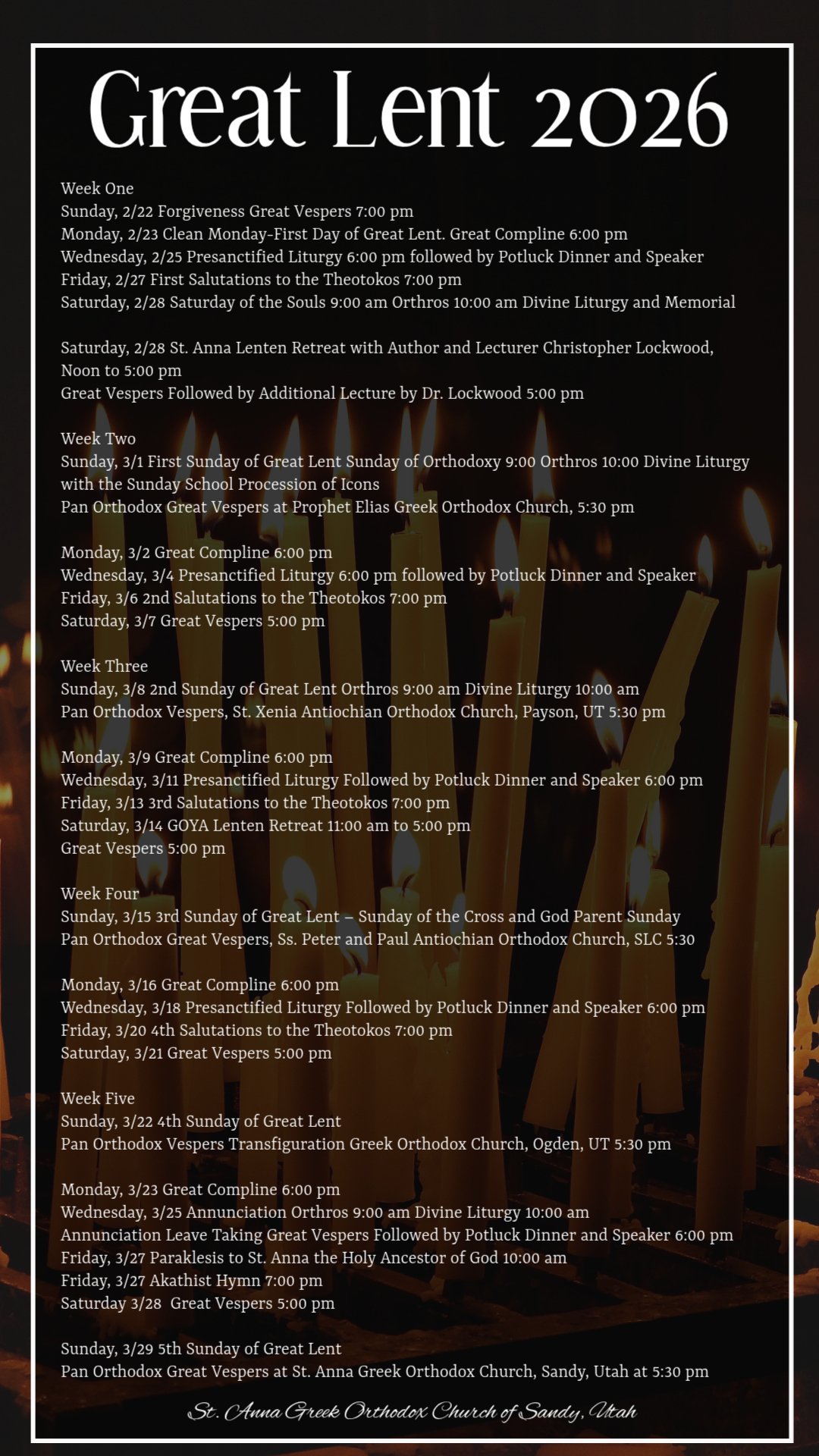
For the past several years, our parish has been accustomed to experiencing our Lenten Retreats toward the end of the season. This year, I wanted us to get a jump on our Lenten inspiration and literally start off as immediately as possible. Next Saturday, from Noon to 5:00 pm (with a bonus talk following Great Vespers at 5:00 pm) renowned author, professor, lecturer and theologian, Dr. Christopher Lockwood will lead our Retreat. This young man is one of the sharpest minds in the modern Orthodox Christian world. He is a graduate of our Holy Cross Greek Orthodox School of Theology and earned his Ph.D. from the University of Thessaloniki. In fact, our own parish council member Sam Soter, while traveling in Greece was with Christopher as he defended his dissertation.
His latest book, “Types and Symbols in the Bible” is available in the Bookstore, and he will take the time to sign copies while here. Dr. Lockwood is also a teacher of Byzantine Music. He will be with us for the Sunday of Orthodoxy services; helping to chant the Orthros, and deliver the homily in the Divine Liturgy. Please, make every effort to be with us for this fantastic opportunity to learn and grown in our Faith. A light Lenten luncheon will be served. You really do not want to miss this!
With Love in Christ,
Fr. Anthony Savas
Protopresbyter
Categories
Weekly Bulletin for February 22, 2026
Categories
Weekly Bulletin for February 15, 2026

Dear Brothers and Sisters in Christ,
Today, February 8th, the Church celebrates St. Theodore the Commander.
The holy Martyr Theodore was from Euchaita of Galatia and dwelt in Heraclea of Pontus. He was a renowned commander in the military, and the report came to the Emperor Licinius that he was a Christian and abominated the idols. Licinius therefore sent certain men to him from Nicomedia, to honor him and ask him to appear before him. Through them, however, Saint Theodore sent back a message that it was necessary for various reasons, that Licinius come to Heraclea. Licinius, seeing in this a hope of turning Saint Theodore away from Christ did as was asked of him.
When the Emperor came to Heraclea, Saint Theodore met him with honor, and the Emperor in turn gave Theodore his hand, believing that through him he would be able to draw the Christians to the worship of his idols. Seated upon his throne in the midst of the people, he publicly bade Theodore offer sacrifice to the gods. But Theodore asked that the emperor entrust him with the most venerable of his gods, those of gold and silver, that he might take them home and himself attend upon them that evening, promising that the following day he would honor them in public. The Emperor, filled with joy at these tidings, gave command that Theodore’s request be fulfilled.
When the Saint had taken the idols home, he broke them in pieces and distributed the gold and silver to the poor by night. The next day a centurion named Maxentius told Licinius that he had seen a pauper pass by carrying the head of Artemis. Saint Theodore, far from repenting of this, confessed Christ boldly. Licinius, in an uncontainable fury, had the Saint put to many torments, then crucified. While upon the cross, the holy Martyr was further tormented — his privy parts were cut off, he was shot with arrows, his eyes were put out, and he was left on the cross to die. The next day Licinius sent men to take his corpse and cast it into the sea; but they found the Saint alive and perfectly whole.
Through this, many believed in Christ. Seeing his own men turning to Christ, and the city in an uproar, Licinius had Theodore beheaded, about the year 320. The Saint’s holy relics were returned to his ancestral home on June 8, which is also a feast of the Great Martyr Theodore.
Through his intercessions before Christ, may the Great Martyr St. Theodore bless and inspire you all. I remain,
With Love in XC,
Fr. Anthony Savas
Protopresbyter
Categories
Weekly Bulletin for February 8, 2026
O Lord and Master of my life, take from me the spirit of sloth, faintheartedness, the lust of power, and idle talk.
But give rather the spirit of chastity, humility, patience, and love to your servant.
Yea, O Lord, and King grant me to see my own sin and not to judge my brother, for You are blessed from all ages to all ages.
Amen.
Prayer of St. Ephraim the Syrian
Dear Brothers and Sisters in Christ,
Today, Sunday February 1st begins the month long pre-Lenten period known as the Triodion. It is a Greek word meaning three odes, that is, three stanzas. The word “ωδή” refers to stanzas of praise or hymns, from the verb of αείδώ “to sing”. This period has been called “Triodion” because the primary hymns of most of the church calendar year are replaced with the liturgical book with Canons of 3 odes called “The Triodion”. In other words, this period of pre-preparation before the Great and Holy Lent is literally named after the liturgical book which contains the hymns for this time of year.
The Triodion period takes its name from the book that we use in this ecclesiastical time.
The use of the Triodion book begins with Sunday of the Publican and Pharisee and lasts until Holy Saturday, that is the day before Pascha. Though the Triodion Period is generally understood to include the four Sundays before the beginning Lent.
It is a time of special compunction, a return to oneself and to God, in order to rise with Christ as a new creation in sincere repentance.
It is a time of self-purification when we cry: “O God have mercy on me, a sinner.”
This is what we read in the Synaxarion of the beginning of the Triodion: “O Creator of all above and below, as You receive the thrice-holy hymn from the angels, so also from mankind receive the Triodion”.
Heaven and Earth join to form a single choir. Angels and humans come together to praise the “Creator of all”, angels sing lauds to the Holy Trinity (Trisagion- the Thrice Holy Hymn) and human beings respond with honorable odes of the Triodion, filled with compunction.
The author of the Triodion, Nikephoros Kallistos Xanthopoulos, says that the three odes were first composed by Cosmas of the Hymnographer, Bishop of Maiuma who arranged them after the model of the life-giving Holy Trinity to be chanted on Holy Week. Then several authors including Theodore and Joseph of the Studite Monastery in Constantinople followed him; they wrote Canons for each week of Great Lent.
The Triodion is characterized by three hymns that are chanted at Matins after the Gospel and Psalm 50, from the Sunday of the Publican and Pharisee to the Sunday of Saint Mary of Egypt.
These hymns form a liturgical unit inspired by Psalm 50; they begin thus:
– “Glory to the Father and the Son and the Holy Spirit…Open unto me the Gates of Repentance…”
– “Both now and ever and unto the ages of ages. Amen…Guide me on the paths of salvation, O Theotokos…”
– “Have mercy on me O God…As I the wretched one ponder the multitude of evil deeds I have done…”
The Triodion Sundays
-The Sunday of the Publican and Pharisee (Luke 18:10-14)
On this Sunday, the gospel reading is the parable given by the Lord about the virtues of repentance and humility. It shows how much these virtues are dear to God, even more than the apparent sacrifices and worship with a spirit of pride and arrogance.
Consequently, the Church warns that the cornerstone of Great Lent is the humility with a spirit of repentance.
Setting the Gospel of the Publican and Pharisee on the first Sunday is mostly to emphasize humility.
When St. Macarius was asked, “What is the greatest virtue?” He replied, “Just as arrogance brought down an angel from the highest and caused the first humans to fall, so does humility raise the person endowed with it from the lowest pit.”
Saint Isaac the Syrian says on humility: “The one who sighs every day because of his sins is greater than one who raises the dead. It is better to deserve beholding one’s sins than beholding angels”.
Anyone who views himself as being sinless falls in delusion and pride (1John 8:1). We are in constant need to cry unto God with the Publican “God, be merciful to me a sinner!’ (Luke 18:13).
No matter how many virtues we acquire, let us always remember that we are sinners and ask God for mercy and forgiveness.
Kontakion Hymn for the Sunday of the Publican and Pharisee:
Let us flee the proud speaking of the Pharisee and learn the humility of the Publican, and with groaning let us cry unto the Savior: Be merciful to us, for You alone are ready to forgive.
– Sunday of the Prodigal Son (Luke 15:11-32)
On this Sunday, the gospel reading is the parable given by the Lord about the profligate son who wasted his father’s wealth, but then repented and returned to him.
This parable is mainly about the endless love of God who awaits our return to Him. We are all children of God by adoption, while true repentance is a kind of resurrection and life.
Most beautiful in this proverb is the expression “he came to himself”. Coming to oneself is a turning and correction point. When a person calms down from the inside, they begin to think about their condition and discover that there is no peace, no salvation, nor tranquility except in returning to the embracing paternal home, especially after they realize the bitterness of alienation from God and the sweetness of returning to Him.
Kontakion Hymn for the Sunday of the Prodigal Son:
When I disobeyed in ignorance Your fatherly glory, I wasted in iniquities the riches that You gave me. Wherefore, I cry to You with the voice of the prodigal son, saying, I have sinned before You, O compassionate Father, receive me repentant, and make me as one of Your hired servants.
– Sunday of Judgement (Meatfare Sunday) (Matthew 25:31-46)
On this Sunday, we read the Gospel of Judgment, just as Jesus Christ describes His Second Coming in the Gospel of Matthew. He compares the humans whom He created to cattle, because the image of the shepherd is common about God in the Old Testament, and it is also a common image of priests (see the prophecies of Isaiah, Jeremiah and Ezekiel 34:11).
In the New Testament, Christ likens himself to the Shepherd, knowing that it is also the Lamb that takes away the sin of the world. Since He suffered for our sake, only His love can judge the ingratitude of the world.
This gospel on Meatfare Sunday is meant to make us realize the importance of true love towards others because our neighbor is the Lord Jesus Christ Himself; it is as we are standing before Him.
One is his own judge; all his actions are revealed plainly before God’s righteous judgment.
St Jerome (4th century) says: Remember Christ each time you stretch your hand to give… The true temple of Christ is the believer’s soul; adorn this, clothe it, offer gifts to it, welcome Christ in it. What use are walls blazing with jewels when Christ in His poor Matthew 25:40 is in danger of perishing from hunger?
St Cyprian of Carthage highlights the importance of adhering to Christ with all our life, says: “But it may be, dearest brethren, that Christ himself is the kingdom of God, for whose coming we daily ask. For since He is our resurrection since in him we rise again, so also the kingdom of God may be understood to be himself since it is in him that we shall reign”.
On this Sunday we stop eating meat (food with blood) to enter little by little the peaceful condition of the kingdom of God like the first humans before the Fall.
Kontakion Hymn for Meatfare Sunday:
When You come, O God, upon the earth with glory, the whole world will tremble. The river of fire will bring men before Your judgment seat, the books will be opened and the secrets disclosed. Then deliver me from the unquenchable fire and count me worthy to stand on Your right hand, Judge most righteous.
The Sunday of Forgiveness (Cheesefare)
It is also the memory of Adam’s expulsion from Paradise. On this Sunday before the commencement of Great Lent, the Church assigns to read a Gospel from the Sermon on the Mount, and stresses the importance of mercy and reconciliation with people before the sacrifice of fasting is brought near.
This gospel on Sunday before the beginning of Lent is meant to help us realize the importance of forgiveness. We ask God to forgive us our sins after having forgiven others; it is a sine qua non. We cannot fast while hating others! God does not accept the prayer of a person who holds grudges!
Fasting is a journey of reconciliation with God. But the Lord equals us to Himself; he even equals our neighbor to Himself saying: If you do not reconcile with your relative, you cannot reconcile me, and vice versa.
The Lord Jesus did not comment on any request in the Lord’s Prayer other than asking for forgiveness: “For if you forgive men their trespasses, your heavenly Father will also forgive you. But if you do not forgive men their trespasses, neither will your Father forgive your trespasses (Matthew 6:14-15).
Starting this Sunday, complete fasting begins to stop dairy and meats.
Are you ready?!?
Kontakion Hymn for Cheesefare Sunday:
O Master, Guide to wisdom, Giver of prudent counsel, Instructor of the foolish and Champion of the poor, make firm my heart and grant it understanding. O Word of the Father, give me words, for see, I shall not stop my lips from crying out to You: I am fallen, in Your compassion have mercy on me.
Most beloved in the Lord, these are the themes that will gently guide us into the dawn of the Lenten Season. We will be softly guided to the unthinkable depths of spiritual knowledge. We will discover, through Christ, the heights of God’s tender mercies. And we will attain such lofty places by bringing ourselves to our knees. Through humility, we are exalted. As we are cast out in sin, we are received through repentance. We fall to the lowest depths, so that we can aspire to the arching span of the heavens.
Fr. Anthony Savas
Protopresbyter
Categories