Categories
Pastoral Letters

Pastoral Message September 4, 2022

The Children and Teachers Present at our 2022-2023 Sunday School Year Blessing.

Dear Brothers and Sisters in Christ,

I want to thank the teachers, the children and their families who participated in last week’s Blessing upon our new Sunday School Year. We honored our teachers for their past years of service and called upon all children in attendance, to participate in the Sanctification of our efforts to learn and teach the Gospel, the Traditions of our Faith, and the history of our Church. Days into the same week, we celebrated the New Ecclesiastical Year on September 1st. And then days into next week, we will again turn our spiritual attention to the celebration of youth – as we celebrate the Nativity of the Theotokos on the 8th of September, then the Synaxis (Gathering) of her parents, Ss. Joachim and Anna, the following day, on September 9th.

The record of the birth of Mary is not found in the Bible. The traditional account of the event is taken from the apocryphal writings which are not part of the New Testament scriptures. The traditional teaching which is celebrated in the hymns and verses of the festal liturgy is that Joachim and Anna were a pious Jewish couple who were among the small and faithful remnant—“the poor and the needy”—who were awaiting the promised messiah.

The couple was old and childless. They prayed earnestly to the Lord for a child, since among the Jews barrenness was a sign of God’s disfavor. In answer to their prayers, and as the reward of their unwavering fidelity to God, the elderly couple was blessed with the child who was destined, because of her own personal goodness and holiness, to become the Mother of the Messiah-Christ.

Your nativity, O Virgin, has proclaimed joy to the whole universe. The Sun of Righteousness, Christ our God, has shone from you, O Theotokos. By annulling the curse, he bestowed a blessing. By destroying death he has granted us eternal life.

Troparion

By your nativity, O most pure virgin, Joachim and Anna are freed from barrenness; Adam and Eve from the corruption of death. And we, your people, freed from the guilt of sin, celebrate and sing to you: The barren woman gives birth to the Theotokos, the Nourisher of our Life.

Kontakion

The fact that there is no Biblical verification of the facts of Mary’s birth is incidental to the meaning of the feast. Even if the actual background of the event as celebrated in the Church is questionable from an historical point of view, the divine meaning of it “for us men and for our salvation” is obvious. There had to be one born of human flesh and blood who would be spiritually capable of being the Mother of Christ, and she herself had to be born into the world of persons who were spiritually capable of being her parents.

The feast of the Nativity of the Theotokos, therefore, is a glorification of Mary’s birth, of Mary herself and of her righteous parents. It is a celebration as well of the very first preparation of the salvation of the world. For the “Vessel of Light,” the “Book of the Word of Life,” the “Door to the Orient,” the “Throne of Wisdom” is being prepared on earth by God Himself in the birth of the holy girl-child Mary.

The verses of the feast are filled with titles for Mary such as those in the quotations above. They are inspired by the message of the Bible, both the Old and New Testaments. The specific Biblical readings of the feast give indications of this.

At Vespers the three Old Testament readings are “Mariological” in their New Testament interpretation. Thus, Jacob’s Ladder which unites heaven and earth and the place which is named “the house of God” and the “gate of heaven” (Gen 28.10–17) are taken, to indicate the union of God with men which is realized most fully and perfectly—both spiritually and physically—in Mary the Theotokos, Bearer of God. So also, the vision of the temple with the “door ‘to the East’” perpetually closed and filled with the “glory of the Lord” symbolizes Mary, called in the hymns of the feast “the living temple of God filled with the divine Glory” (Ezek 43.27–44.4). Mary is also identified with the “house” which the Divine Wisdom has built for himself according to the reading from Proverbs 9.1–11.

The Gospel reading of Matins is the one read at all feasts of the Theotokos, the famous Magnificat from Saint Luke in which Mary says: “My soul magnifies the Lord, and my spirit rejoices in God my Saviour, for he has regarded the low estate of his handmaiden, for behold, henceforth all generations will call me blessed” (Lk 1.47).

The epistle reading of the Divine Liturgy is the famous passage about the coming of the Son of God in “the form of a servant, being born in the likeness of man” (Phil 2.5–11) and the gospel reading is that which is always read for feasts of the Theotokos—the woman in the crowd glorifies the Mother of Jesus, and the Lord himself responds that the same blessedness which his mother receives is for all “who hear the word of God and keep it” (Lk 11.27–28).

Thus, on the feast of the Nativity of the Theotokos, as on all liturgical celebrations of Christ’s Mother, we proclaim and celebrate that through God’s graciousness to mankind every Christian receives what the Theotokos receives, the “great mercy” which is given to human persons because of Christ’s birth from the Virgin.

On September 9, the Greek Orthodox Church celebrates the Synaxis of the Ancestors of God Saints Joachim and Anna, which refers to the gathering of the faithful after the Feast of the Nativity of Theotokos, honoring the commemoration of the parents of Panagia, the Most Holy Theotokos.

The righteous Joachim and Anna were childless for fifty years of their married life. In their old age, the Archangel Gabriel appeared to each one of them separately, telling them that God had heard their prayers and that they would give birth to a daughter, Mary. Then St. Anna conceived by her husband and after nine months bore a daughter blessed by God and by all generations of men: the Most-holy Virgin Mary, the Theotokos.

St. Joachim was of the lineage of Judah and a descendant of King David. Anna was the daughter of Matthan the priest, from the lineage of Levi, as was Aaron the high priest. Matthan had three daughters: Mary, Sophia and Anna. Mary married, lived in Bethlehem, and gave birth to Salome; Sophia married, also lived in Bethlehem, and gave birth to Elizabeth, the mother of St. John the Forerunner; Anna married Joachim in Nazareth, and in old age gave birth to Mary, the Most-Holy Theotokos.

Joachim and Anna had lived together in marriage for fifty years and yet had remained barren. They lived devoutly and quietly, and of all their income they spent one third on themselves, distributed one third to the poor and gave the other third to the Temple, and they were well provided for. Once when in their old age they came to Jerusalem to offer a sacrifice to God, the high priest Issachar reprimanded Joachim, saying: “You are not worthy that a gift be accepted from your hands, for you are childless.”

Others, who had children, pushed Joachim behind them as “unworthy.” This greatly grieved these two aged souls, and they returned home in great sorrow. Then the two of them fell down before God in prayer, that He works a miracle with them as He once had with Abraham and Sarah and give them a child as a comfort in their old age. Then God sent His angel, who announced to them the birth of “a daughter most-blessed, by whom all nations on earth will be blessed and through whom the salvation of the world will come.” Anna straightway conceived, and in nine months gave birth to the Holy Virgin Mary.

Saint Joachim died a few years later at the age of 80 after his daughter went to live in the Temple. Saint Anna died at the age of 70, two years after her husband. Saints Joachim and Anna are often invoked by couples trying to have children.

With Love in Christ,

Fr. Anthony Savas
Protopresbyter

Categories
Bulletins

Weekly Bulletin for September 4, 2022

Weekly Bulletin for September 4, 2022 Fellowship Request Bible Study 2022-2023 Adult Education 2022-2023

Categories
Pastoral Letters

Pastoral Message August 28, 2022

Dear Brothers and Sisters in Christ,

This past Wednesday, the Orthodox world lost the Western World’s greatest Luminary of an entire generation, with the passing of Metropolitan Kallistos of Diokleia. I have had the distinct joy of attending at least three of his lectures during my adult life. And his books The Orthodox Church and The Orthodox Way were profoundly influential to my spiritual growth as a teen. He was the voice of the Eastern Christian expression to our hemisphere.  His voice was soft, yet powerful. His writings were academic, yet relatable. He taught, blessed, authored, translated and inspired. 

For many, countless individuals who were either introduced to Orthodoxy, or who were re-introduced to Orthodoxy in the last decades of the past century, up until today, chances are…you were introduced by “Timothy Ware.” He guided us through the structure, theology, doctrine and teachings of the Church he adopted as a young man. The dignity he so exuded, was a gift from God.

He was oh, so, British! Classy, refined, distinguished! He blended together worlds that should have been miles apart, both culturally and religiously. But there was Metropolitan Kallistos – a bridge between heaven and earth, and between dichotomous dots on the globe. 

We read his books in my high school Sunday School Classes. I have referenced, reflected upon, and re-visited them innumerably since. His translation/publication of the Festal Menaion was for me, as a young priest, a critical resource in celebrating the divine rites of the church – for his was the only English translation of many church services. Today, we take these resources for granted – tapping a button on our phones, and instantly retrieving any desired liturgical text in an instant. However in 1997, you better had purchased the weighty, light-blue covered, hard back book that referenced what to chant at Christmas, Epiphany, Great Lent, Holy Week and Pascha. What would we have done, how could we have served, to whom could we have turned, were it not for the efforts of His Excellency, Metropolitan Kallistos.

Since my exposure to this fine, Man of God, was only superficial, I would like to share the following article, written by one of his former students, Fr. John Chryssavgis – who is himself, a world-wide respected scholar. He paints a personal and vivid picture of this erstwhile theologian and spiritual father. Please pray for his blessed soul. Give thanks to God for his influential voice – from the lecture halls of Oxford University to the classrooms of every church, everywhere. Bless the Memory of Kallistos Ware! Enjoy:

This article originally appeared in Religion News Service on August 24, 2022.

Remembering Kallistos Ware, Revered Orthodox Christian Theologian

The renowned and popular Orthodox Christian theologian of recent decades died Wednesday (Aug. 24) at 87.

(RNS) — Metropolitan Kallistos Ware, without a doubt the most renowned and popular Orthodox Christian theologian of recent decades, died on Wednesday (Aug. 24) at 87. A convert to Orthodox faith, he became bishop of the see of Diokleia and was considered the most prolific and proficient communicator of patristic theology and Orthodox spirituality in our generation. 

For more than 30 years until retiring in 2001, he taught at Oxford University in England (where I studied with him for three years) and was known as an assiduous scholar, punctilious lecturer and conscientious adviser. He also served as parish priest at the Oxford Orthodox community that housed the Greek and Russian congregations. Indeed, what drew many, including me, to Oxford was his rare combination of the scholarly and spiritual, academia and asceticism, of patristic literature and profound liturgy — of Orthodox Christianity as a living and life-changing tradition. 

Born Timothy Ware in 1934, he came to Oxford to study classics and theology. He was received into the Orthodox faith in 1958, and after some years spent in monasteries in Canada and at the Monastery of St. John the Theologian on the island of Patmos, where the Book of Revelation was written, he was ordained a priest in 1966. He was elected to the rank of bishop in 1982, and later metropolitan, a title of higher distinction in the Eastern Orthodox Church. For the rest of his life he was an avid researcher, prolific writer, brilliant exponent and desired speaker.

He was a punctilious and measured man. The day we first met, in September 1980, we had lunch at his academic home, Oxford’s Pembroke College. Ware brought along a stack of books for me, proposed an essay title and said he’d see me again in three weeks. Otherwise we talked about the menu of the dining hall. The next time we met at his parental home. Ware served me tea and a banana on a plate, with cutlery. He neatly peeled and sliced his banana; I obliged him by drinking the tea, but told him I preferred to take the fruit back to my room. For a young student accustomed to more casual ways in my native Australia and in Greece, it was a brusque awakening.

The world will remember Ware as the author of “The Orthodox Church,” still the quintessential introduction to the Orthodox Church, and its companion, “The Orthodox Way.” But for me he will always be first and foremost the translator, with Mother Mary of the Orthodox Monastery of the Holy Veil in France, of “The Festal Menaion” and “The Lenten Triodion,” the core liturgical books of the Orthodox Church, completed in 1969 and 1977 respectively.

With Gerald Palmer and Philip Sherrard, he edited the complete text of “The Philokalia,” a collection of writings by early church and Orthodox mystics. In 1995, Denise Sherrard wrote to tell me that her husband completed the draft of the translation only weeks prior to his repose. Ware, for his part, finished with the final proofs of the fifth and final volume just weeks before he died, attending to its index until his last breath.

Ware’s unique and provocative combination of scholarship and spirituality was a powerful influence. Comfortable serving as a priest at Holy Trinity Church as he was researching in the Bodleian Library and chairing the faculty of theology, he spent countless hours visiting patients in hospitals and parishioners in restaurants or businesses. He was as much on fire delivering a lecture on the desert fathers or the Palamite controversy as he was delivering a sermon on a solemn Holy Week service or a regular Sunday liturgy — all with a distinctive and ingenious wit.

In his first sermon as bishop, in June of 1982, he suggested that the diverse lives of the saints reveal that each of us is a unique way of, and to, salvation. In his weekly sermons, he emphasized the power of the name of Jesus, the call to self-awareness, the expectation of trials and the primacy of thanksgiving. He underlined prayer as offering glory, instead of listing complaints, and interpreted liturgy as the occasion for the Lord to act rather than an opportunity for us to worship. 

He kept track of these sermons: He once admitted that he was repeating a sermon from five years earlier, shrewdly observing that it was all right to repeat a sermon, so long as it wasn’t a bad one the first time around.

But it is as a father confessor and spiritual guide that he may have made his most lasting mark. Arguably the most vivid image I have of Ware is the endless line of parishioners approaching the upper left corner of the nave at Holy Trinity at Great Vespers on Saturday Vigil. They came from many backgrounds, education levels and cultures, all there to offer a word of confession and receive a word of consolation.

Ware would exhort you to pay attention to little things: the icon you venerated, the person you encountered, the gift of the present. He was convinced of Christianity’s constant surprise and limitless wonder; it could never be contained or constricted to a stagnant past and stereotypical tradition. It found you where you are: To Ware, it made perfect sense that reorganizing one’s index cards and filing system could be used as a prudent and beneficial Lenten discipline for the soul.

Ware will be remembered far beyond Oxford, or even Orthodoxy. He was as confident debating with Anglican and Catholic clerics or theologians as he was among Greek, Russian, Serbian or Romanian Orthodox thinkers. He was longtime editor (with George Every and John Saward) of the pioneering journal Eastern Churches Review and lifelong advocate (with the likes of the Rev. Lev Gillet) for the Anglican-Orthodox Ecumenical Fellowship of St. Alban and St. Sergius. He served as joint president of the international commissions for Orthodox-Anglican and Orthodox-Roman Catholic dialogue, and despite concerns and reservations he promoted and participated in the Holy and Great Council of the Orthodox Church in 2016.

Thoroughly ecumenical, he was an English gentleman through and through. Orthodox to the bone, he nevertheless considered himself a perennial apprentice of the faith, once stating how he looked forward to browsing through heaven’s library.

He never imagined himself contorting the Orthodox faith to personal conventions or apprehensions, but ever perceived himself as willing to be shaped, perhaps surprised by its newness. It is not coincidental that his personal memoir, “Journey to the Orthodox Church,” appeared only a decade ago, when, as a mature critical thinker, he could discern how the church had changed over his lifetime. He emphasized the struggle to espouse the heart of the Orthodox faith as well as to embrace its paradoxes, antitheses and polarities.

In this way, he was capable of both informing and criticizing developments in the Orthodox Church, Greek and Russian alike. He was also humble enough to recognize his limitations and miscalculations. He admitted that the 2007 Document of Ravenna “on communion, conciliarity and authority,” which concerned some theologians because it highlighted the authenticity of a universal primacy, was in fact sound. He encouraged discussion of women’s ordination along with dispassionate conversation on gender and sexuality — both of course to the rancorous disapproval of the usual suspects. He endorsed an Orthodox ecological doctrine as fundamentally and essentially rooted in the dogma of creation and incarnation.

I never stopped being his student. He was supportive at every new dimension and turn of my ministry and teaching. He guided and read everything that I wrote over the last 30 years, which included preparing — when he was already quite ill — the foreword to my latest publication on the fifth-century elders from Gaza, Barsanuphius and John, whose letters he introduced me to as his student.

I was delighted to dedicate this book to him; and I was elated that he held it in his hands only days before surrendering his spirit to the Lord. I can imagine him right now waiting for the grandfather clock to strike with precision for the moment when he will open the door to his book-strewn heavenly library.

John Chryssavgis, the author of more than 40 books on Orthodox theology and spirituality, is archdeacon of the Ecumenical Patriarchate and special theological adviser to the Greek Orthodox Archdiocese of America. The views expressed in this commentary do not necessarily reflect those of Religion News Service.

May His Memory be Eternal,

Fr. Anthony Savas
Protopresbyter
St. Anna Greek Orthodox Church

Categories
Bulletins

Weekly Bulletin for August 28, 2022

Weekly Bulletin for August 28, 2022 Fellowship Request Bible Study 2022-2023 Adult Education 2022-2023 Sunday School 2022 Sundae School 2022 YAL BBQ 2022

Categories
Pastoral Letters

Pastoral Message August 21, 2022

Dear Brothers and Sisters in Christ,

I trust and pray that all is well, and you are feeling the abundant love of Christ in your lives. As I seem to share every year around this time, we are entering into my favorite season. Schools are beginning (way too early), today is a crispy, rainy day, the leaves will soon change, and a full calendar of services, events, classes and ministries will again, come fully alive. I think we had something like 28 days of 100-degree temperatures the past several weeks. Yes, I am ready for autumn. 

So much of what we do, and how we schedule the activities of the parish really does orbit the school calendar. If you have kids in school or not, our educational system has a strong influence on our daily living. What’s available in stores, sports and entertainment choices, the fact that vacations are over, and we need to settle into patterns and programs, are all part of the reality of the season. Fun’s over. Get back to work!

But the beauty of this turning point in the calendar, is grounded, at least for me, in the knowledge that fundamental needs and our higher priorities are once again brought to the forefront. “Back to School” is not simply a slogan for stores, malls and shopping sites. Nor is it limited to football games, homecoming dances, and renewed friendships. Getting back into the classroom; the secular classroom or the St. Anna Sunday School classroom, means that concepts, ideas and information will once again flow freely. Minds will be enriched; imaginations will be inspired and, in church any way, the knowledge of Christ, His Church, His holy traditions, His Saints, His sacramental life, His ministry, His gift of everlasting life can be absorbed, actualized and put into practice.

Knowledge and education are fundamental needs.  We are busily crafting and finalizing the calendar of spiritual education programming at St. Anna’s, for all age groups. New and continuing opportunities are ever expanding, and I am looking forward to sharing the start dates and times by this time next week. I know that modern school districts are telling us that mid-August is the start of the process, but my brain is still programmed for September. 

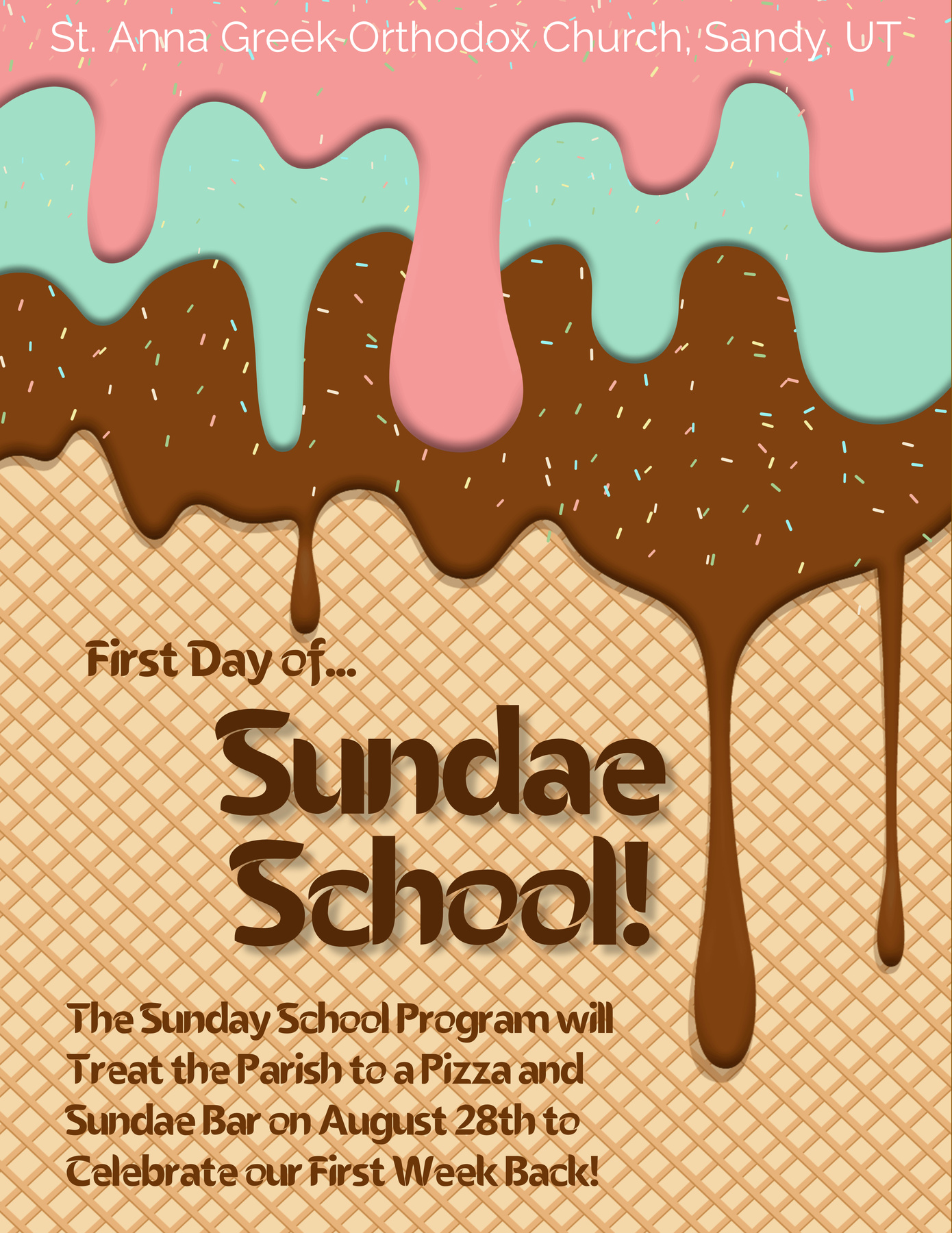
Registration emails have been sent to the continuing and new families of our Sunday School program. If you have not been contacted personally, please use the QR Code on the attached flyer and sign up your child(ren), grandchild(ren) or godchild(ren). I truly ask the forgiveness of anyone I may have not contacted. We will bless the New School Year next Sunday, take a quick Labor Day Weekend break and begin actual classes on September 11, 2022.

We are finalizing times for our Evening Bible Study, Daytime Bible Study, Orthodox Inquirer’s Class, Spiritual Book Study, Parish Nights, and Chanting Classes. Wow. That’s a lot! Please afford yourself the opportunity to grow in your Faith in any and all classes taught at St. Anna’s. 

Finally, I would like to bring your attention to another fundamental aspect of life – literally – blood. For the past several years, Beverly Bartel has led the efforts at St. Anna’s to host blood drives, at least on an annual basis. Our next drive, open to the public, will take place this coming Wednesday. At the time of scheduling, we weren’t quite sure where it would be staged. But I suppose an advantage to slow-moving construction is a conveniently placed blood drive – to be held in the social hall. If able, please be responsive, there are ten spots open for the day. These are the most spots we’ve had open this late. 

Following is Bev’s final message for this week’s initiative: 

LAST CALL FOR BLOOD DONORS

FOLLOW THE LINK BELOW TO SIGN UP

10 SPOTS LEFT

WEDNESDAY, AUGUST 24

12:30-6:30

ST. ANNA GREEK ORTHODOX CHURCH

 CLICK HERE to schedule an appointment.

We hope you will sign up! 

I pray that this evening’s Tables Extraordinaire will be fun and successful. And I very much look forward to seeing you all in church tomorrow.  You might want to come and see the progress on the bell tower (spoiler alert – buried at the bottom of an email – the bells arrive on September 9th!) We look forward to blessing them in the church the following Sunday. Watch for details. Ooooh. It’s getting very real and very exciting. Praise be to God!

With Much Love in XC, 

Fr. Anthony Savas
Protopresbyter

Categories
Bulletins

Weekly Bulletin for August 21, 2022

Weekly Bulletin for August 21, 2022 GOYA Hike 2022 YAL BBQ 2022 Sunday School 2022 Red Cross Blood Drive

Categories
Pastoral Letters

Pastoral Message August 14, 2022

Dear Brothers and Sisters in Christ,

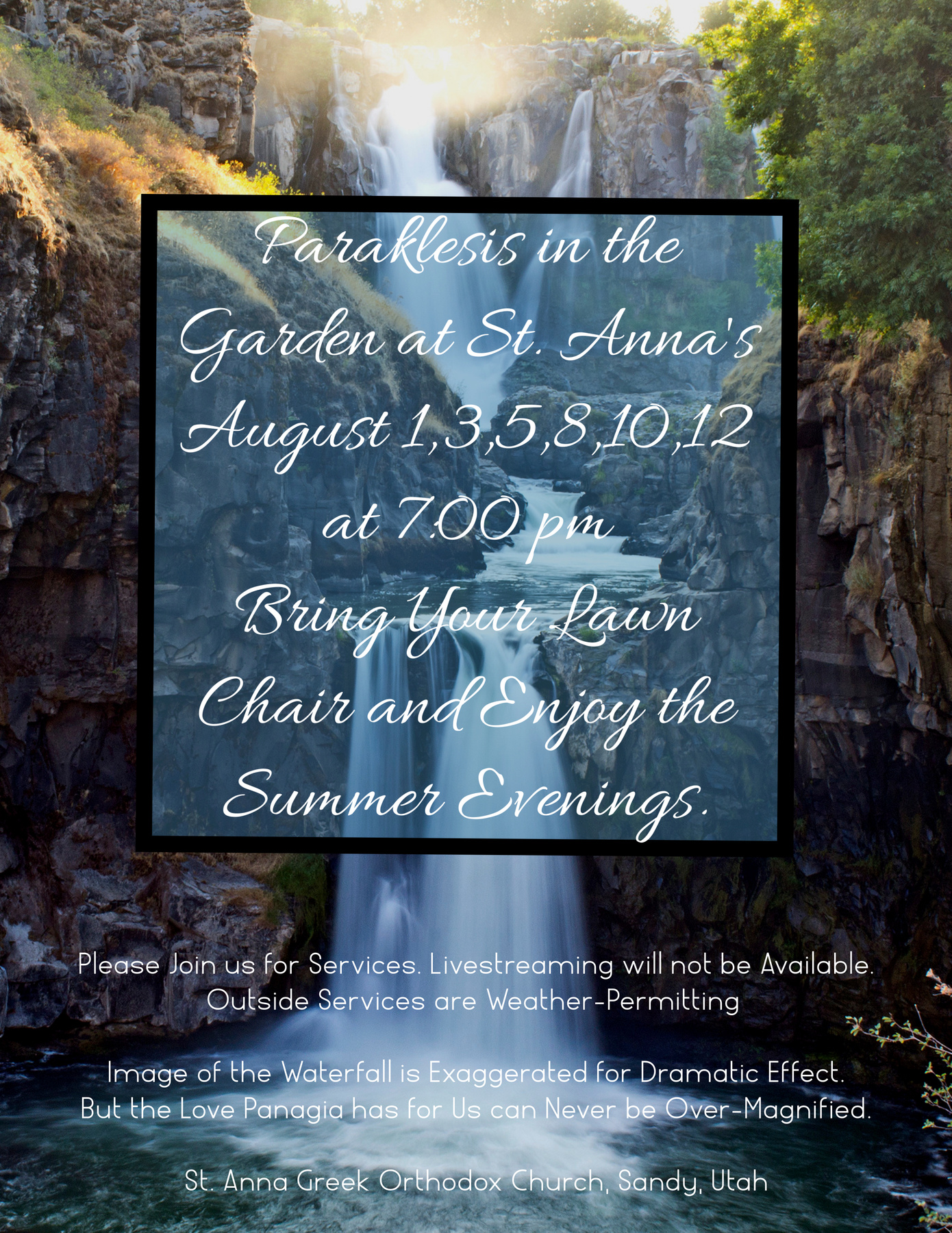
Tomorrow morning, Sunday, August 14th, we will celebrate the Forefeast of the Dormition of the Theotokos. This is how the Church calls our full attention to the culmination of our Two-Week Fast in honor of the falling asleep of the Theotokos. For the past several evenings, we have gathered as a community of faith to pray the Paraklesis Service to the Mother of God, in preparation for the days immediately ahead. August 15th is referred to as the “Summer Pascha,” as we grieve the earthly loss of the Theotokos. She who inspires, protects, sustains, encourages, safeguards, consoles, sooths and uplifts will depart from this world and be lifted into eternity; to share a forever existence with her Son and her Lord, Jesus Christ. 

How deeply saddened must the Disciples have been at the hearing of her passing. Her continued ministry of prayer, courage and strength must have sustained them from the time of Christ’s Ascension, then into the extreme reaches of their missionary journeys. They traveled far and wide to spread the Good News of the Gospel and the message that Christ had indeed risen from the dead in order to free humankind from sin, death and destruction. As word spread of her death to each of them, I imagine that the pain of seeing their Lord on the Cross, revisited them, piercing the depths of their souls. Once again, they mourned.

We celebrate her passing because her goodness cannot be contained on earth. Her appointment from God to bear His Son and bring salvation to the world has now completed a full circle. She can now fully appreciate, understand and participate in the saving ministry of her Son. The ministry that she, herself made possible!

Hers is s ministry of generosity, grace, strength and selflessness. Which inspires the ministries of some other fine, ladies you may know.

Typically, I place an appropriate icon at the top of these messages, so you can be visually inspired before reading a single word of my humble, written offerings. But tonight, it is not an icon, but rather a photograph that “leads this story.”

A picture, not of the Theotokos, but rather, several women who continue her passion of caring, serving and giving. 

Last week, we received two dignitaries from the Metropolis of Denver Philoptochos Board. Current president, Stella Piches, and past president, Barbara Vittas visited the ladies of our (soon to be former) Women’s Ministry Team. They came to offer instruction and encouragement in the transformation of our local ministry effort, into an official Philoptochos Chapter at St. Anna’s. 

Philoptochos, which in Greek, literally means “Friends of the Poor,” is our national and Archdiocesan women’s philanthropic auxiliary. It is comprised of local chapters (in parishes), Metropolis Boards and an Archdiocesan Board. The work they do is nothing less than miraculous. They offer assistance in every capacity and serve the needs of those less fortunate throughout the world.

In other words, they do on a larger scale, what our women have been doing for the past eight years. Only now, our ladies will be going about their philanthropic work, tapping into the recourses of a greater, national body. In the coming weeks, once we receive our official charter number, we will set out to establish our St. Anna Philoptochos Chapter in Sandy, Utah.

I am ever grateful that Panaghia’s imprint of love for those in need is thriving, and central to the mission of St. Anna’s. There will be no greater witness of this than the ladies of our Philoptochos – together with our Men’s and Service Ministry Teams. The Theotokos, as she is assumed into the heavens will smile upon the work of our parish women. She will bless their efforts. She will strengthen their resolve. She will send her limitless love. 

Most Holy Theotokos, Intercede for Us!

With Much Love in Christ,

Fr. Anthony Savas
Protopresbyter
Categories
Bulletins

Weekly Bulletin for August 14, 2022

Weekly Bulletin for August 14, 2022 GOYA Hike 2022 YAL BBQ 2022 Sunday School 2022 Red Cross Blood Drive

Categories
Pastoral Letters

Pastoral Message August 7, 2022

You were transfigured upon the mountain, O Christ our God, showing to Your disciples Your glory as much as they could bear. Do also in us, sinners though we may be, shine Your everlasting light, by the intercessions of the Theotokos, O Giver of light. Glory to You.

Hymn of the Transfiguration of Christ

Dear Brothers and Sisters in Christ,

In every Divine Liturgy of the Orthodox Church, we address our prayers and thanksgiving to God who is described as “ineffable, inconceivable, invisible, incomprehensible, ever-existing and always the same.” This kind of language – which tries to describe God by saying what he is not – is called apophatic or “negative” language. Apophatic language is the language of prayer; it points to God’s majesty and transcendence while, at the same time, it conveys His presence. God is absolutely transcendent – beyond anything that we can know and experience – yet He is also present (immanent) and acts on behalf of us for our salvation. We will never fully understand Who God is. But we are pretty sure of what His is not.

The Feasts of the Church celebrate those acts of salvation. They not only remember certain special events but make Christ present to us in those events through the power of the Holy Spirit. In the feast of the Nativity of Christ, we see revealed to us the mystery of God’s incarnation in the flesh. God manifests Himself to us, reveals Himself to us as man while yet remaining God. The feast of the Nativity of Christ is the celebration of that act of God revealing Himself to us, in His Coming to earth as a man. In the feast of Theophany, we see Christ revealed as the “Beloved Son” of God the Father.

At Christ’s baptism in the Jordan, God makes it clear that this man Jesus is truly the “Son of God.” And now, as we prepare to celebrate the feast of the Transfiguration of Christ tomorrow morning, we see Christ being revealed in all His divine glory. In each feast Christ comes to us now, manifests or makes Himself present to us so that we can come to truly know Him.
The feast of Christ’s transfiguration – metamorphosis – celebrated on August 6 was introduced as a separate feast with all its major characteristics sometime between the sixth and eighth centuries. It was more widely known in the East than in the West and takes on a greater significance for Eastern Christians.

The Fathers of the Church stress in their sermons that Jesus, when He was transfigured before His disciples, did not add anything to His nature that He did not possess before, but revealed what He already was. Jesus’ humanity was not changed into divinity at the Transfiguration; He was divine, but in this event, His divine glory was revealed.
Several details appear in the event which express also the unity of the Old and New Testaments. The appearance of Jesus with Moses and Elijah indicates that Jesus is not a violator of the law, nor a blasphemer, but the one whom the law and the prophets had looked toward. The past (Moses and Elijah), the present (the kingdom of God already here) and the future (crucifixion, resurrection and the world to come) make up the content of the event.

The early Fathers regarded the Transfiguration, like Epiphany, as a sign of the transformation of human nature and of the reality of salvation. For salvation, they stressed, cannot be accomplished without the transfiguration of human nature by the power of God. Therefore, the feast of the Transfiguration is also the day of the celebration of the deification (theosis) of human nature. On this day all human nature was illuminated by the divine transfiguration. In this event, humanity reveals divinity. Finally, the Trinity is revealed in the Transfiguration, as it was in the Epiphany.

The Transfiguration of Christ is a major Feast of Christ. Let us enjoy it together. 

With Much Love in our Transfigured Lord,

Fr. Anthony Savas
Protopresbyter
Categories
Bulletins

Weekly Bulletin for August 7, 2022

Weekly Bulletin for August 7, 2022 YAL BBQ 2022 Sunday School 2022 Paraklesis in the Garden 2022 Philoptochos Invitation Red Cross Blood Drive