Categories
Pastoral Letters

Pastoral Message April 10, 2022

The image of God was faithfully preserved in you, O Mother. For you took up the Cross and followed Christ.By Your actions you taught us to look beyond the flesh for it passes, rather to be concerned about the soul which is immortal.
Wherefore, O Holy Mary, your soul rejoices with the angels.

Hymn of St. Mary of Egypt

Dear Brothers and Sisters in Christ,

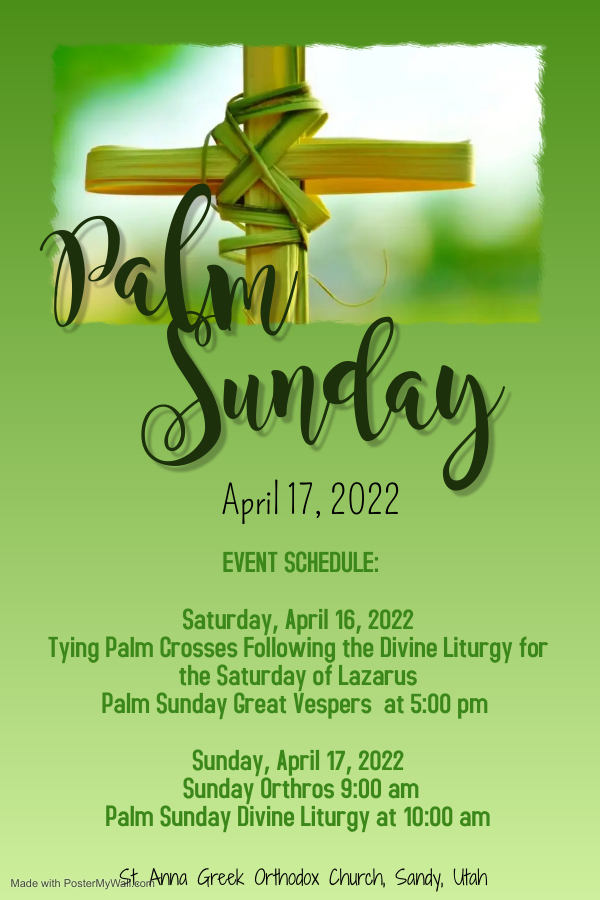
Tomorrow, we come to the fifth and final Sunday of Great Lent. The next time we gather for Sunday worship, we will usher Christ triumphantly into Jerusalem with the commemoration of Palm Sunday (see attached flyer). But tomorrow, we have presented to us, the unique life, trials and glory of St. Mary of Egypt.

St. Mary of Egypt left nothing but an oral account of her life when she met St. Zossimas of Palestine. After she slept in the Lord, her life story was passed down orally by the fathers at his monastery, until St. Sophronius, Patriarch of Jerusalem, recorded it around the end of 7th century AD.

According to this account, St. Mary lived during the reign of the Emperor Justinian, in mid-6th century AD. She was born in Egypt in a small town outside Alexandria. In her early teen years she fled her home and went to Alexandria where she lived for about seventeen years in poverty but also in promiscuity, giving herself freely to any man who would spend a few hours with her. 

St. Mary was about thirty years old when she heard of a pilgrimage to Jerusalem and the Holy Land. She decided to join the group but did not have enough money to pay for the trip, so she arranged to offer her body in exchange for the fare. When the pilgrim group arrived in Jerusalem, they went to the Church of the Holy Sepulcher to venerate the Precious Cross of our Lord Jesus Christ. St. Mary found that it was impossible for her to enter; she was held back by a mysterious force like an invisible wall standing in front of her. She then realized that her careless and sinful life prevented her from venerating the Holy Cross. 

She broke into tears of repentance, praying to the Theotokos to help her. Immediately, the invisible wall disappeared and Mary entered the church, kneeled in front of the icon of the Theotokos, and then venerated the Holy Cross. At that moment, she heard a voice telling her to go to the desert of the River Jordan where she would have the help, guidance, and protection of the Theotokos. 

Mary did as she was told, and traveled to the desert on foot. She lived there in total solitude, battling her passions, crying, praying, and eating and sleeping as little as possible. In her darkest hours, she had the help of the Theotokos who never abandoned her. After years of toiling in solitude,

St. Mary reached the highest level of perfection: her body was not in need of clothes or nutrition, and by God’s Grace she was granted the gift of foreseeing.  

Forty-seven years after St. Mary retreated in the desert, another monastic, St. Zossimas, who, as was the tradition at his monastery, had gone to dwell in the desert during Great Lent, reached the place of her seclusion. St. Mary approached him in a miraculous way, told him her life story, and asked him to come again the following year to offer her Holy Communion. St. Zossimas was amazed to have discovered this hidden ascetic, more so a woman, who had reached spiritual perfection.

St. Zossimas visited St. Mary again the next year on Holy Thursday. To reach him, St. Mary crossed the Jordan River without touching the water. She received Holy Communion, and returned to the desert. The following year, St. Zossimas went out again to meet the Saint, and found her dead body peacefully lying on the ground. An inscription nearby informed him that she had slept in the Lord right after receiving Holy Communion, and instructed him to do her funeral service and bury her body. St. Zossimas did as instructed. It is said that a lion came to help him dig St. Mary’s grave. Upon return to his monastery, he shared the precious secret with the brotherhood, and St. Mary’s story was passed on orally until written down about a century later. (Account from Orthodox Pebbles)

Much Love in XC,

Fr. Anthony Savas

Protopresbyter

Categories
Bulletins

Weekly Bulletin for April 10, 2022

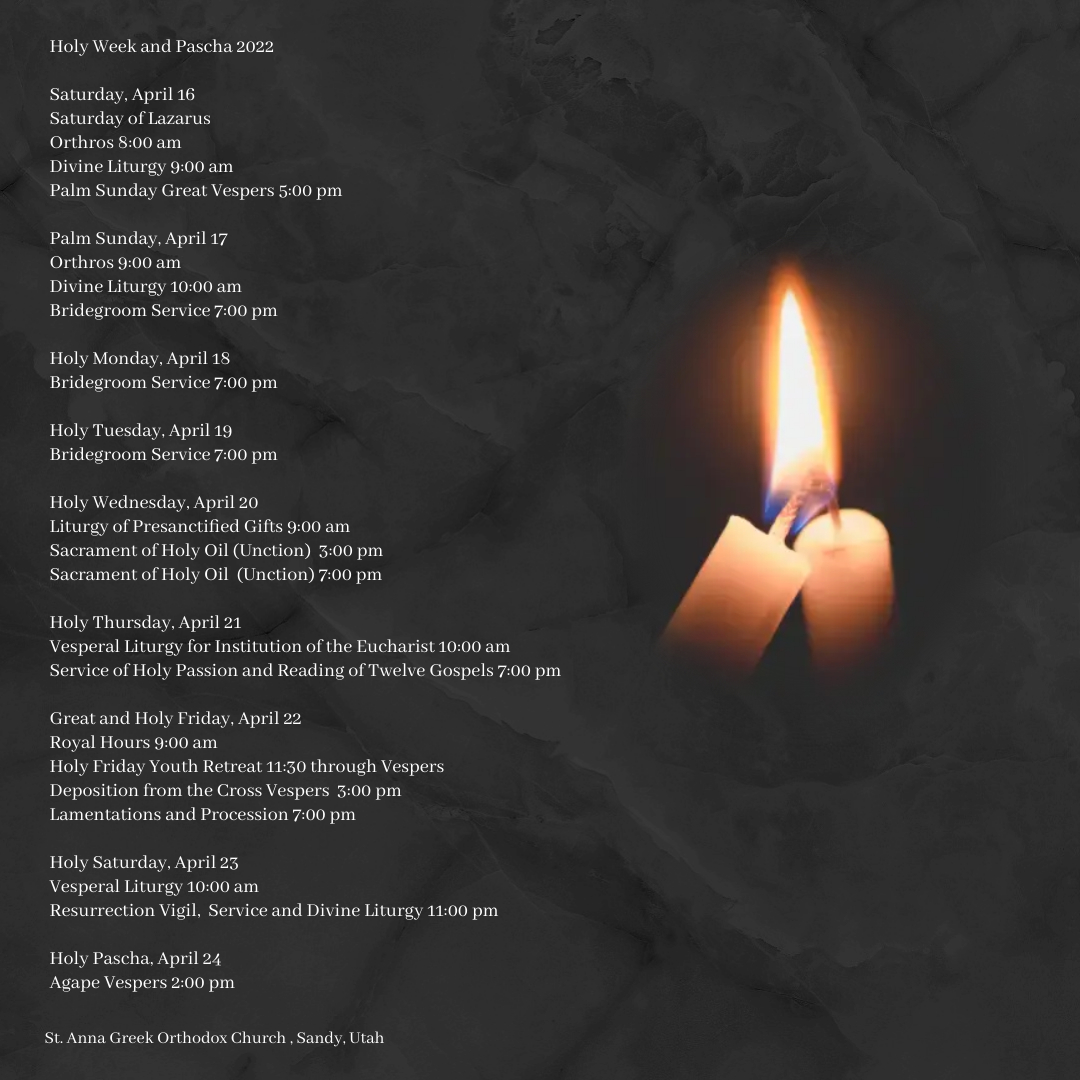
Weekly Bulletin for April 10, 2022 Palm Sunday 2022 Holy Week and Pascha Schedule 2022 St. Anna Golf Tournament 2022

Categories
Pastoral Letters

Pastoral Message April 3, 2022

Dear Brothers and Sisters in Christ,

How much it must grieve a father or a mother to see his or her child suffering without reason. To undergo pain and confusion — for what? Where is God in our plight — we may often ask ourselves. Where is God in all this pain and confusion?

Today we arrive at the fourth week of Lent. In today’s Gospel reading we heard of a father who was on his last hope. His son was possessed by a certain spirit from childhood, which was causing his son pain and confusion. Not even Jesus’ disciples could cure the boy. He brought his son to Jesus, who upon hearing of the father’s plight became exceedingly upset at the whole crowd and expressed these strong and direct words “Oh you faithless generation, how much longer must I be with you? How much longer must I put up with you.” The Child was immediately brought close to Jesus and the spirit convulsed him instantly. As we know the child was eventually healed. But at what price one may ask? The father accepted and confessed his unbelief and beseeched God with tears to make his faith complete? This is the price, the fulfillment of our faith — payed by Christ himself yet we must pray and beseech Him as well.

It is perhaps important to stress here that this miracle account nowhere refers to the spirit by any title such as demon, or devil. It is perhaps because this spirit is in reference to the spirit of this world, the enemy of Christ. It is the spirit of this generation well rooted in society, it is passed on to our children like a virus. Brethren remember these words well — it is the spirit of this generation which throws our youth about like the child with the spirit we heard earlier today. It smashes them to the ground, it throws them into the fire to be burnt, it throws them into the water to be drowned — today its drugs, alcohol, gambling, anything to distort the image and likeness of God, within them.

This spirit has a very old history going way back to primordial Man, Adam and Eve. It is firmly established and can not come out by anything — except, as our Lord instructed Moses, as our Lord instructed his disciples, as our Lord instructs us today, by beseeching God through prayer and fasting.

“Why could we not cast it out”, his disciples asked their master in shame. We also must ask why can’t we cast this spirit out from our lives and our children’s lives?

Brethren, because as our Lord tells us “This kind can come out by nothing except prayer and fasting”. This is the key to contrite repentance. this twofold formula which treads on the head of this serpent of old and yields our first step towards heaven — contrite repentance.

It is no coincidence then that the first and second steps of Saint John’s 30 chapter book The Ladder (of Divine Ascent) are concerned with the renunciation of this life, this world we live in and detachment from all it’s pleasures. We honor Saint John of the Ladder today as a great Saint of our church who reminds us that going to heaven is not as easy as getting into an elevator and pressing a button. On the contrary, it is a long and hazardous climb which is impossible to scale fully unless we beseech God for assistance. May God grant us all fullness of faith, peace and joy on our climb to heaven — Amen. (From the Orthodox Research Institute)


With Love in Christ,

Fr. Anthony Savas
Protopresbyter

Categories
Bulletins

Weekly Bulletin for April 3, 2022

Weekly Bulletin for April 3, 2022 Lenten Schedule 2022 Holy Week and Pascha Schedule 2022 St. Anna Bookstore Lent and Pascha Catalog St. Anna Golf Tournament 2022

Categories
Pastoral Letters

Pastoral Message March 27, 2022

O Lord, save Your people and bless Your inheritance; grant victory to the faithful over their adversaries. And protect Your commonwealth, by the power of Your Cross.

Hymn of the Precious and Live-Giving Cross

Dear Brothers and Sisters in Christ,

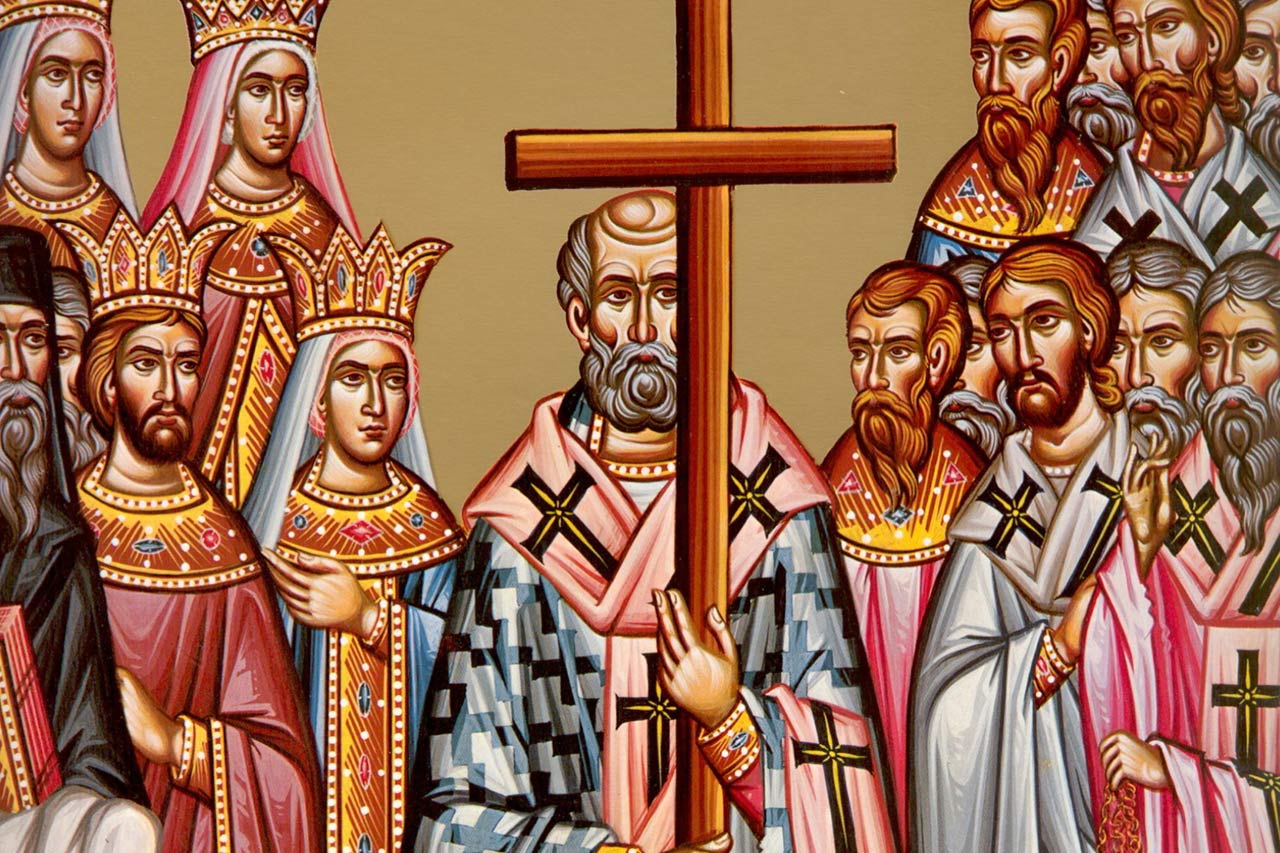
Tomorrow, on the Third Sunday of Great and Holy Lent, the Orthodox Church commemorates the Precious and Life-Giving Cross of our Lord and Savior Jesus Christ. Services include a special veneration of the Cross, which prepares the faithful for the commemoration of the Crucifixion during Holy Week.

The commemoration and ceremonies of the Third Sunday of Lent are closely parallel to the feasts of the Veneration of the Cross (September 14) and the Procession of the Cross (August 1). Not only does the Sunday of the Holy Cross prepare us for commemoration of the Crucifixion, but it also reminds us that the whole of Lent is a period when we are crucified with Christ.

As we have “crucified the flesh with its passions and desires” (Galatians 5:24), and will have mortified ourselves during these forty days of the Fast, the precious and life-giving Cross is now placed before us to refresh our souls and encourage us who may be filled with a sense of bitterness, resentment, and depression. The Cross reminds us of the Passion of our Lord, and by presenting to us His example, it encourages us to follow Him in struggle and sacrifice, being refreshed, assured, and comforted. In other words, we must experience what the Lord experienced during His Passion – being humiliated in a shameful manner. The Cross teaches us that through pain and suffering we shall see the fulfillment of our hopes: the heavenly inheritance and eternal glory.

As they who walk on a long and hard way and are bowed down by fatigue find great relief and strengthening under the cool shade of a leafy tree, so do we find comfort, refreshment, and rejuvenation under the Life-giving Cross, which our Fathers “planted” on this Sunday. Thus, we are fortified and enabled to continue our Lenten journey with a light step, rested and encouraged.

Or, as before the arrival of the king, his royal standards, trophies, and emblems of victory come in procession and then the king himself appears in a triumphant parade, jubilant and rejoicing in his victory and filling those under him with joy, so does the Feast of the Cross precede the coming of our King, Jesus Christ. It warns us that He is about to proclaim His victory over death and appear to us in the glory of the Resurrection. His Life-Giving Cross is His royal scepter, and by venerating it we are filled with joy, rendering Him glory. Therefore, we become ready to welcome our King, who shall manifestly triumph over the powers of darkness.

The present feast has been placed in the middle of Great Lent for another reason. The Fast can be likened to the spring of Marah whose waters the children of Israel encountered in the wilderness. This water was undrinkable due to its bitterness but became sweet when the Holy Prophet Moses dipped the wood into its depth. Likewise, the wood of the Cross sweetens the days of the Fast, which are bitter and often grievous because of our tears. Yet Christ comforts us during our course through the desert of the Fast, guiding and leading us by His hand to the spiritual Jerusalem on high by the power of His Resurrection.

Moreover, as the Holy Cross is called the Tree of Life, it is placed in the middle of the Fast, as the ancient tree of life was placed in the middle of the garden of Eden. By this, our Holy Fathers wished to remind us of Adam’s gluttony as well as the fact that through this Tree has condemnation been abolished. Therefore, if we bind ourselves to the Holy Cross, we shall never encounter death but shall inherit life eternal.

Source Greek Orthodox Archdiocese of America

Fr. Anthony Savas
Protopresbyter

Categories
Bulletins

Weekly Bulletin for March 27, 2022

Weekly Bulletin for March 27, 2022 Lenten Schedule 2022 Holy Week and Pascha Schedule 2022 St. Anna Bookstore Lent and Pascha Catalog

Categories
Bulletins

Weekly Bulletin for March 20, 2022

Weekly Bulletin for March 20, 2022 Lenten Schedule 2022 Holy Week and Pascha Schedule 2022 St. Anna Bookstore Lent and Pascha Catalog

Categories
Bulletins

Weekly Bulletin for March 13, 2022

Weekly Bulletin for March 13, 2022 Lenten Schedule 2022

Categories
Pastoral Letters

Pastoral Message March 6, 2022

Dear Brothers and Sisters in Christ,

Even with the blessings of Great Lent which is immediately upon us, there are no words that can, or should, take our attention away from the catastrophic atrocities that are taking place some 6,000 miles away in Ukraine. As Christians, we pray for the safety of the innocents and hope that the balm of peace can heal the wounds of war. I am no expert on any subject that speaks to this situation at hand. I recently read an article written by the Rev. Dr. John Chryssavgis,  a former professor at Holy Cross Greek Orthodox School of Theology and spokesman of the Ecumenical Patriarchate. His is a voice I trust.

Dn. John is a brilliant scholar and a tremendously beautiful human being. He offered his thoughts on the invasion of Ukraine and its implication on the Church and society. We, as Orthodox Christians – lay people, clergy, hierarchs in particularly must take seriously the words of Dn. John. They will challenge us, they will jolt us, they will convict us, they will inspire us to strive to be imitators of Christ.


May God be merciful to us. May He make His face to shine upon us. May He bless us. 

Dn. John:

Few, if any, would go so far as to claim that Patriarch Kirill, as head of the Orthodox Church in Russia (or “the Russias,” as he likes to say), could be charged with crimes against humanity or war crimes for not preventing unwarranted and unjustifiable military aggression that has cost innocent lives in just the last few days. At the same time, many, if not most, would concur that President Putin should be charged with such atrocities.

Even with his egregious violations of conventional law, however, Putin could never destroy the international order by himself without the loyal support and moral endorsement—whether silent or explicit—of a complicit partner-in-crime. Both state and church there dream of a larger world, a universal Russia, a “Russian World” (Russkiy Mir). But when the punching gloves and the bling vestments are removed, each is using the other for its own interests for imperialism or irredentism; and both are promoting division in an increasingly bi-polar world.

Edward Gibbon long ago derided: “So intimate is the connection between throne and altar, that the banner of the church has very seldom been seen on the side of the people.” In the end, for Putin, the church is merely instrumental, just another arrow in his quiver to reconstitute the Soviet Union, an atheist state. But this time it is under the guise of a Christian theocracy refashioned in the image of the Romanov dynasty, whose double-headed eagle has replaced the Soviet hammer and sickle throughout Russia. Just as Kirill, too, is more than happy to oblige in the re-creation of a powerful church machine aligned with and backed by the state. No blurring of church-state lines here. As for their “soldiers”—secular military and spiritual militants—God alone knows what they have been told they are fighting for.

The critical question, of course, is how the rest of us respond to this 9/11 moment for Europe and the rest of the world. Friends and colleagues have addressed geopolitical aspects or religious ideologies at stake. Without reducing a horrific crime to an academic conversation—whether sociological or ecclesiastical, psychological or geopolitical—I want to limit myself to a personal perspective and experience. I trust that the reader will appreciate my reluctance to lecture or posture on history or theology, and ecclesiology or canon law, when the invasion still rages.

As a clergyman, never in my life have I been so horrified by the pathetic reactions of leaders in my church to current events in the past several years. At the very same time as they scurried to prepare pre-Lenten sermons on the “judgment passages” in Matthew 25 or preach on abstaining from meat—which they define as animals with a backbone!—they issued the most anemic statements about the war of Russia on Ukraine, unable to go beyond the call to pray, while forgetting that Christ himself demonstrated indignation at injustice.

I was hardly as surprised when they blundered more recently through COVID-19, with responses ranging from outright asininity to blatant irresponsibility. But I could not help but compare the tepid assurances of prayers to reactions after mass shootings. And I certainly could not help but wonder why bishops who proudly  parade in “right to life” marches did not take to the streets for the “right to defense” of their Ukrainian—Orthodox in so many cases—brothers and sisters. At least Pope Francis stepped outside his office and stepped inside his Fiat to appeal in person to the Russian ambassador. The Archbishop of Canterbury unequivocally condemned Russia’s attack on Ukraine as “an act of great evil.” And the Ecumenical Patriarchate is the only Orthodox Church outside Ukraine to decry Russia’s unprovoked actions as “a violation of human rights and brutal violence against human beings.”

The reality is that the Orthodox Churches have abysmally neglected over the centuries to instruct or inspire their congregations in a way that meaningfully influences and shapes civil society about assuming a stand before socio-political challenges or standing up to failures of a broken state. The truth is that through most of history they have painfully succumbed or perversely submitted to the state, hardly disposed or competent to stand beside a laity exposed to the church’s impotence and the state’s ignorance. How tragic that it was left to the fearless protesters in Moscow, St. Petersburg, and elsewhere in Russia to expose both.

As an American, never in my life have I been so astounded by the partisan breakdown of support for and criticism of Putin, who is dismantling basic norms once taken for granted. The same ideological clash of worldviews is reflected in our own domestic context, where basic norms are likewise under threat. Still, the admiration of certain political pundits for Putin’s clever strategy or worthy ideals is almost unprecedented, rivalled only by the commensurate admiration of certain Orthodox Christians for Putin’s strong faith and deep piety.

I sincerely hope that fellow Americans will not be fixated on prices at the gas pump, for which the administration resorts to apologizing to the public and which the opposition reduces to accusations against the government. Hopefully we have learned from the last European war about the perils of silence and indifference, of waiting too long before confronting Hitler. Hopefully, too, we have learned that the world order—and not just Ukraine’s freedom—is at stake, as embattled Ukrainian President Zelensky has bravely articulated in videos from Kyiv, crying in a wilderness.

Putin has brazenly violated the international order, just as Kirill has flagrantly ignored the ecclesiastical order by breaking communion with the Ecumenical Patriarchate over its right to grant autocephaly to the Orthodox Church in Ukraine, another courageous breakaway from Kirill’s Russias. The response of the global community (including the United States) will determine whether and how law prevails in the long term. And the response of the religious community (including the Orthodox Church) will determine whether and how love prevails in the long term.

If faith has taught me something, it is that, in the grand scheme of things, progress is possible and even inevitable. Whether with reluctance or resistance, Russia will at some point be forced to disabuse itself of its historical dreams or ideological destiny and walk with the rest of the world in the twenty-first century. Whether the Orthodox leaders know it or like it, the world may take a step backward for a period of time, but it will invariably move many more steps forward.

History may sometimes flatter “sophisticated” villains—secular and spiritual. But history never flatters shameless villains—who do not even pretend to charm their constituents. And if theology has taught me something, it is that, in the far-reaching perspective of God, evil never prevails over good. Sin can never be the final or perpetual word. Neither will Putin’s monstrosity. Nor, quite frankly, will Kirill’s passivity.


Rev. Dr. John Chryssavgis is a deacon of the Greek Orthodox Archdiocese of America.


With Love in Christ,

Fr. Anthony Savas
Protopresbyter

Categories
Bulletins

Weekly Bulletin for March 6, 2022

Weekly Bulletin for March 6, 2022 Lenten Schedule 2022 Construction Update