Categories
Pastoral Letters

Pastoral Message December 5, 2021

Dear Brothers and Sisters in Christ,

I pray and trust that you are all well and that the joy of Christmastime is blessing your homes. When you come to church this weekend, tomorrow for St. Barbara, and Sunday, you will see a transformed space thanks to the gifted hands and eyes of Sandra Zoolakis and Stephanie Chachas. Thanks also to Chuck Karpakis for the heavy lifting and to Jim Karpakis for donating the large Christmas Tree that is placed in the sanctuary. Merry Christmas!

As you are surely aware, all of the ministry and administrative events that were scheduled for this Sunday have been supplanted to Sunday, December 12th. That is, Stewardship Sunday, the Special Parish Assembly, and the 2021 Parish Council Election. Please allow me to share some thoughts about these events.

Stewardship Sunday

For the past several years, we have treated the blessing of our Stewardship Offerings as a special and prayerful event. We have been distributing 2022 Pledge Packets for the past couple of weeks. It is important for people to pick them up as soon as possible. That way you have time to prayerfully contemplate your Pledge, and it saves the church the costs to mail these large envelopes. Please, please, please be swift, deliberate and thoughtful in your 2022 Pledge.

We will be mailing the packets out on Monday so that as many Pledge Cards as possible can be blessed upon the Altar as an offering to God. Since we are still not at pre-Covid capacity on Sundays, I presently have the fewest returned Pledge Cards at this point. Hope to see you in church this weekend, and with your packet in hand. Thanks in advance for your continued commitment!

Special Parish Assembly

At the Fall Parish Assembly, you were introduced to our final plans, layout and timeline for our massive renovation project. You have all been very patient and understanding as we conduct worship, fellowship, ministry activities, classes, rehearsals and meetings in the wide-open interior space of our building. God willing, and with the good pleasure of our St. Anna Community, we will soon have a permanent sanctuary, ballroom space, classrooms, new bathrooms, offices, a kitchen and storage. Not to mention the transformed exterior with the bell tower and appropriate crosses on the building. The entire cost will be about $2.5 million dollars. We have a plan. We have the means. We have the vision. We have the faith to execute such a large undertaking. Be sure to have your 2021 Stewardship up to date in order to vote. Be present and let your voice be heard.

On Monday, December 6th, the Feast of St. Nicholas the Wonderworker, following the celebration of the Divine Liturgy, I am traveling to Denver to receive the blessing of Metropolitan Isaiah. I have not seen His Eminence since Covid times, and I am eager to be in his pastoral, warm and engaging presence. The specific purpose of my visit is to present to him the same information we will share at the Special Parish Assembly. Anything voted upon can only move forward with his guidance and permission. It is important that he see, beforehand, our intentions. That way, once the Assembly has spoken, he can proceed quickly with his archepastoral blessing upon our project. Let us build our House unto the glory of God!

Parish Council Election

There are five seats open on the Parish Council and nine people have been properly nominated to fill those positions for a two-year term. I wish I could just add all of these new candidates to our current and complete board. But that is not possible or my call to make. Your voice, the collective voice and individual voices of the parish, choose our leadership. Each and every one of them are capable, faithful and engaged. Please pray upon their names, faces and experiences. 

Jacob Dennis

Jacob currently assists Leo in the chanting of our services and also sings in the choir. He is in the technology field and has always demonstrated a tender love for our St. Anna parish.                           

Doug Felice

Though Doug is only recently Christmated in the Orthodox Faith, he has been a parishioner of St. Anna’s for the past two years. He is an engineering consultant and former Marine. Very committed. 

Tom Leitko

Tom is a retired professor, consultant and analyst. He has designed and executed all of our parish surveys and currently sits on or all-important Medical Advisory Ministry Team.  Tom is a gifted leader.                           

Elaine Peterson 

As the editor of our Parish Bulletin and chairman of our St. Anna Name Day Events, including last year’s successful dinner in honor of the Archbishop, Elaine is a capable and energetic leader.                     

Joseph Sasich

Currently sitting on our Parish Council, Joe brings a great wealth of wisdom, experience, humility and expertise – especially in construction/buildings, especially as we begin our buildout.

George Sergakis

Currently sitting on our Parish Council, George brings his expertise in insurance and business acumen to the parish and its leadership. George is an active, energetic and supportive leader. He’s funny, too!

Bruce Shand

Bruce has served before on our Parish Council, Legal Ministry Team and heads up our efforts in Sustained Giving. Highly organized, highly capable and always willing to serve, Bruce is trusted and valued. 

Steve Simos

Steve currently serves as the Vice President of our Parish Council and has been involved and vital to all decisions concerning operations, stewardship, communications and strategic planning.

Sam Soter

Sam is a successful businessman who then pursued the sacrificial vocation of education and became a high school teacher.  Highly engaging and capable. Sam is always willing to serve. 

If you are in need of an absentee ballot, please follow the instructions on the election notice that has been sent to all parishioners. Craig Stagg will send you a ballot and it will be returned to me. I, in turn will preesent all absentee ballots to the chairman of the election committee on the day of the election.  Well, I suppose this message was more administrative than pastoral. But let us all remember that the business, the activity and the very purpose of a Greek Orthodox Church is to witness, glorify, serve, and celebrate Christ. 

With Much Love in XC,
Fr. Anthony Savas
Protopresbyter
Categories
Bulletins

Weekly Bulletin for December 5, 2021

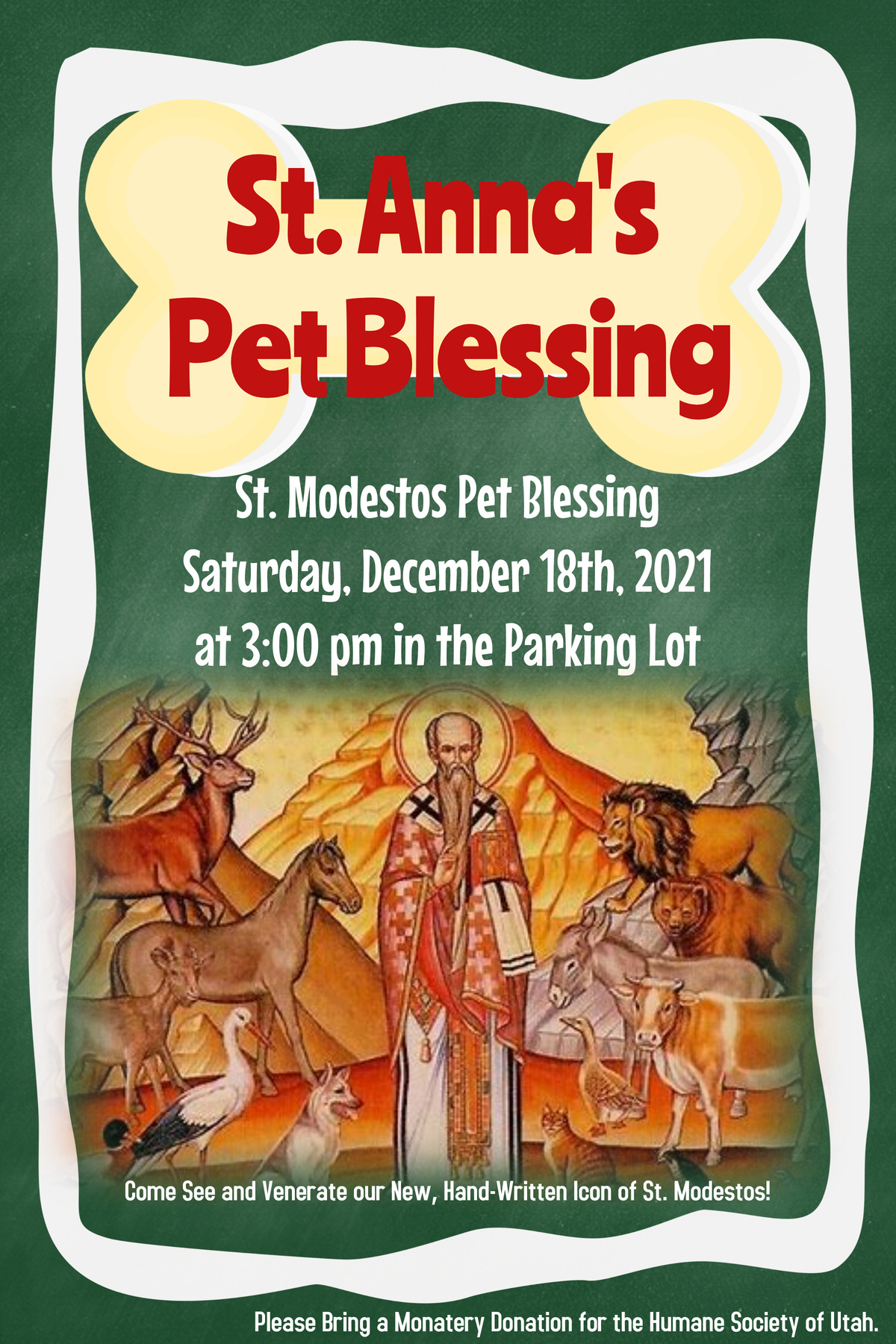
Weekly Bulletin for December 5, 2021 Family Night — Gingerbread House Contest Pet Blessing

Categories
Pastoral Letters

Pastoral Message November 21, 2021

Dear Brothers and Sisters in Christ,

Tomorrow, Sunday, November 21, we celebrate the Feast of the Entrance of the Theotokos. This is the day that the young, toddler, Theotokos was given over to the Temple of Jerusalem by her pious parents Ss. Joachim and Anna, to care for, and raise her; thus fulfilling their promise to God, that if they were given the gift of a child, they would dedicated him or her to His service. 

They gave their daughter the name Mary, or Miriam in Hebrew, which means “Beloved.” They carefully and prayerfully chose her name. 

Our names are important. They define us as much as our physical appearance or reputation. That’s why it’s critical to know the names of the people who are important to us. And that they know our names. We can’t truly hold someone dear to our hearts if we don’t know who they are! 

With all of the new faces we see at St. Anna’s from Sunday to Sunday, we are losing the special gift that we enjoyed as a smaller parish; really knowing each other. Knowing everyone’s name!

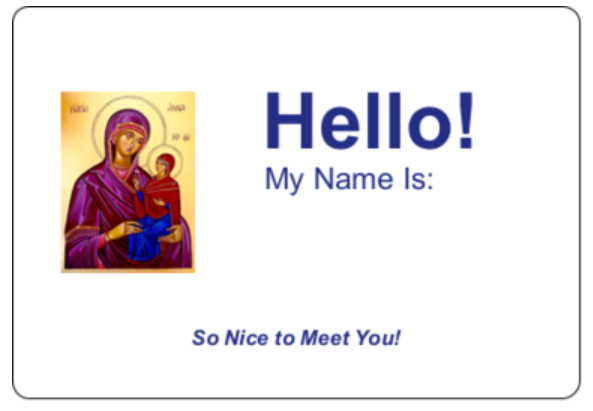
So it was suggested that we hold a Name Tag Sunday, so we can take the quick steps to introducing us to each other. So tomorrow, please fill out a name tag when you come into the Narthex. Wear it proudly and visibly. Take the time to read the names of others, learn their faces, ask about their families. To be sure, we are a growing family. But if we are to remain a family, I ask that we continue the tender and intimate steps of viewing each other accordingly. Just like we did in the beginning. 

With Much Love in Christ,

Fr. Anthony Savas
Protopresbyter

Categories
Bulletins

Weekly Bulletin for November 21 and 28, 2021

Weekly Bulletin for November 21 and 28, 2021

Categories
Pastoral Letters

Pastoral Message November 14, 2021

The grace that from your mouth shone forth like a torch illumined the universe. It deposited in the world the treasures of the absence of avarice. It showed us the height that is attained by humility. Now you instruct us by your words, Father John Chrysostom. Intercede with Christ God, the Word himself, entreating Him to save our souls.

Hymn of St. John Chrysostom

Saint John Chrysostom, Archbishop of Constantinople, one of the Three Hierarchs [January 30], was born at Antioch in about the year 347 into the family of a military commander. His father, Secundus, died soon after the birth of his son. His mother, Anthusa, widowed at twenty years of age, did not seek to remarry but rather devoted all her efforts to the raising of her son in Christian piety. The youth studied under the finest philosophers and rhetoricians. But, scorning the vain disciplines of pagan knowledge, the future hierarch turned himself to the profound study of Holy Scripture and prayerful contemplation. Saint Meletius, Bishop of Antioch (February 12), loved John like a son, guided him in the Faith, and in the year 367 baptized him.

After three years John was tonsured as a Reader. When Saint Meletius had been sent into exile by the emperor Valens in the year 372, John and Theodore (afterwards Bishop of Mopsuestia) studied under the experienced instructors of ascetic life, the presbyters Flavian and Diodorus of Tarsus. The highly refined Diodorus had particular influence upon the youth. When John’s mother died, he embraced monasticism, which he called the “true philosophy.” Soon John and his friend Basil were being considered as candidates for the episcopal office, and they decided to withdraw into the wilderness to avoid this. While Saint John avoided the episcopal rank out of humility, he secretly assisted in Basil’s consecration.

During this period Saint John wrote his “Six Discourses on the Priesthood,” a great work of Orthodox pastoral theology. The saint spent four years struggling in the wilderness, living the ascetic life under the guidance of an experienced spiritual guide. And here he wrote three books entitled, “Against the Opponents of Those Attracted to the Monastic Life”, and a collection entitled, “A Comparison of the Monk with the Emperor” (also known as “Comparison of Imperial Power, Wealth and Eminence, with the True and Christian Wisdom-Loving Monastic Life”), both works which are marked by a profound reflection of the worthiness of the monastic vocation.

For two years, the saint lived in a cave in complete silence, but was obliged to return to Antioch to recover his health. Saint Meletius, the Bishop of Antioch, ordained him deacon in the year 381. The following years were devoted to work on new theological writings: “Concerning Providence” (“To the Ascetic Stagirios”), “Book Concerning Virginity,” “To a Young Widow” (2 discourses), and the “Book of Saint Babylos, and Against Julian and the Pagans.”

In the year 386 Saint John was ordained presbyter by Bishop Flavian of Antioch. Saint John was a splendid preacher, and his inspired words earned him the name “Golden-Mouthed” (“Chrysostom”). For twelve years the saint preached in church, usually twice a week, but sometimes daily, deeply stirring the hearts of his listeners.

In his pastoral zeal to provide Christians with a better understanding of Holy Scripture, Saint John employed hermeneutics, an interpretation and analysis of the Word of God (i.e. exegesis). Among his exegetical works are commentaries on entire books of the Holy Scripture (Genesis, the Psalter, the Gospels of Matthew and John, the Epistles of the Apostle Paul), and also many homilies on individual texts of the Holy Bible, but also instructions on the Feastdays, laudations on the Saints, and also apologetic (i.e. defensive) homilies (against Anomoeans, Judaizers and pagans). As a priest, Saint John zealously fulfilled the Lord’s command to care for the needy. Under Saint John, the Antiochian Church provided sustenance each day to as many as 3,000 virgins and widows, not including in this number the shut-ins, wanderers and the sick.

Saint John began his commentary on Genesis at the beginning of Great Lent in 388, preaching thirty-two homilies during the forty day period. During Holy Week he spoke of how Christ was betrayed, and about the Cross. During Bright Week, his pastoral discourse was devoted to the Resurrection. His exegesis of the Book of Genesis was concluded only at the end of October (388).

At Pascha in the following year the saint began his homilies on the Gospel of John, and toward the end of the year 389 he took up the Gospel of Matthew. In the year 391 the Christians of Antioch listened to his commentary on the Epistles of the holy Apostle Paul to the Romans and to the Corinthians. In 393 he explained the Epistles to the Galatians, the Ephesians, Timothy, Titus, and the Psalms. In his homily on the Epistle to the Ephesians, Saint John denounced a schism in Antioch, “I tell you and I witness before you, that to tear asunder the Church means nothing less than to fall into heresy. The Church is the house of the heavenly Father, one Body and one Spirit.”

The fame of the holy preacher grew, and in the year 397 with the death of Archbishop Nectarius of Constantinople, successor to Saint Gregory the Theologian, Saint John Chrysostom was summoned from Antioch, and elected to the See of Constantinople. At the capital, the holy archpastor was not able to preach as often as he had at Antioch. Many matters awaited the saint’s attention, and he began with the most important — the spiritual perfection of the priesthood. He himself was the best example of this. The financial means apportioned for the archbishop were channeled by the saint into the upkeep of several hospices for the sick and two hostels for pilgrims. He fasted strictly and ate very little food, and usually refused invitations to dine because of his delicate stomach.

The saint’s zeal in spreading the Christian Faith extended not only to the inhabitants of Constantinople, but also to Thrace to include Slavs and Goths, and to Asia Minor and the Pontine region. He established a bishop for the Bosphorus Church in the Crimea. Saint John sent off zealous missionaries to Phoenicia, to Persia, and to the Scythians, to convert pagans to Christ. He also wrote letters to Syria to bring back the Marcionites into the Church, and he accomplished this. Preserving the unity of the Church, the saint would not permit a powerful Gothic military commander, who wanted the emperor to reward his bravery in battle, to open an Arian church at Constantinople. The saint exerted much effort in enhancing the splendor of the church services: he compiled a Liturgy, he introduced antiphonal singing for the all-night Vigil, and he wrote several prayers for the rite of anointing the sick with oil.

The saintly hierarch denounced the dissolute morals of people in the capital, especially at the imperial court, irrespective of person. When the empress Eudoxia connived to confiscate the last properties of the widow and children of a disgraced dignitary, the saint rose to their defense. The arrogant empress would not relent, and nursed a grudge against the archpastor. Eudoxia’s hatred of the saint blazed forth anew when malefactors told her that the saint apparently had her in mind during his sermon on vain women. A court was convened composed of hierarchs who had been justly condemned by Chrysostom: Theophilus of Alexandria, Bishop Severian of Gabala, who had been banished from the capital because of improprieties, and others.

This court of judgment declared Saint John deposed, and that he be executed for his insult to the empress. The emperor decided on exile instead of execution. An angry crowd gathered at the church, resolved to defend their pastor. In order to avoid a riot, Saint John submitted to the authorities. That very night there was an earthquake at Constantinople. The terrified Eudoxia urgently requested the emperor to bring the saint back, and promptly sent a letter to the banished pastor, beseeching him to return. Once more, in the capital church, the saint praised the Lord in a short talk, “For All His Ways.”

The slanderers fled to Alexandria. But after only two months a new denunciation provoked the wrath of Eudoxia. In March 404, an unjust council was convened, decreeing the exile of Saint John. Upon his removal from the capital, a fire reduced the church of Hagia Sophia and also the Senate building to ashes. Devastating barbarian incursions soon followed, and Eudoxia died in October 404. Even pagans regarded these events as God’s punishment for the unjust judgment against the saint.

In Armenia, the saint strove all the more to encourage his spiritual children. In numerous letters (245 are preserved) to bishops in Asia, Africa, Europe and particularly to his friends in Constantinople, Saint John consoled the suffering, guiding and giving support to his followers. In the winter of 406 Saint John was confined to his bed with sickness, but his enemies were not to be appeased. From the capital came orders to transfer Saint John to desolate Pityus in Abkhazia on the Black Sea. Worn out by sickness, the saint began his final journey under military escort, traveling for three months in the rain and frost. He never arrived at his place of exile, for his strength failed him at Comana.

At the crypt of Saint Basiliscus (May 22), Saint John was comforted by a vision of the martyr, who said, “Despair not, brother John! Tomorrow we shall be together.” After receiving the Holy Mysteries, the hierarch fell asleep in the Lord on September 14, 407. His last words were, “Glory to God for all things!”

The holy relics of Saint John Chrysostom were solemnly transferred to Constantinople in the year 438. The disciple of Saint John, the venerable Isidore of Pelusium (February 4), wrote: “The house of David is grown strong, and the house of Saul enfeebled. He is victor over the storms of life, and has entered into heavenly repose.”

Although he died on September 14, Saint John’s celebration was transferred to this day because of the Feast of the Elevation of the Holy Cross. Saint John Chrysostom is also celebrated on January 27 and January 30. (Source: OCA)

Fr. Anthony Savas
Protopresbyter

Categories
Bulletins

Weekly Bulletin for November 14, 2021

Weekly Bulletin for November 14, 2021

Categories
Pastoral Letters

Pastoral Message November 7, 2021

Dear Brothers and Sisters in Christ,

I remember the first time I visited the Greek Island of Aegina. The second largest church in the entire of nation of Greece, the Church of St. Nectarios was still under construction. The exterior was finished but the interior was still in its final stages of completion. The small monastery which holds the tomb of St. Nectarios is a small and intimate testimony to the person of this humble man of God. The massive church dedicated to his name, and built right above the monastery, is a witness to the connection he has to people throughout the world. Always believe, and be comforted in the fact, that he does, indeed, pray for us. Liturgy will be celebrated this week for both the Holy Archangels (Monday), and for St. Nectarios on Tuesday. Please read the following account of his life.

St. Nectarios the great wonderworker of modern times, was born Anastasios Kephalas in Selebria, Thrace on October 1, 1846.

Since his family was poor, Anastasios went to Constantinople when he was fourteen in order to find work. Although he had no money, he asked the captain of a boat to take him. The captain told him to take a walk and then come back. Anastasios understood, and sadly walked away.

The captain gave the order to start the engines, but nothing happened. After several unsuccessful attempts, he looked up into the eyes of Anastasios who stood on the dock. Taking pity on the boy, the captain told him to come aboard. Immediately, the engines started and the boat began to move.

Anastasios found a job with a tobacco merchant in Constantinople, who did not pay him very much. In his desire to share useful information with others, Anastasios wrote down short maxims from spiritual books on the paper bags and packages of the tobacco shop. The customers would read them out of curiosity, and might perhaps derive some benefit from them.

The boy went about barefoot and in ragged clothing, but he trusted in God. Seeing that the merchant received many letters, Anastasios also wanted to write a letter. To whom could he write? Not to his parents, because there were no mail deliveries to his village. Not to his friends, because he had none. Therefore, he decided to write to Christ to tell Him of his needs.

“My little Christ,” he wrote. “I do not have an apron or shoes. You send them to me. You know how much I love you.”

Anastasios sealed the letter and wrote on the outside: “To the Lord Jesus Christ in Heaven.” On his way to mail the letter, he ran into the man who owned a shop opposite the one in which he worked. The man asked him where he was going, and Anastasios whispered something in reply. Seeing the letter in his hands, the man offered to mail it for him, since he was on his way to the post office.

The merchant put the letter in his pocket and assured Anastasios that he would mail it with his own letters. The boy returned to the tobacco shop, filled with happiness. When he took the letter from his pocket to mail it, the merchant happened to notice the address. Astonished and curious, the man could not resist opening the letter to read it. Touched by the boy’s simple faith, the merchant placed some money in an envelope and sent it to him anonymously. Anastasios was filled with joy, and he gave thanks to God.

A few days later, seeing Anastasios dressed somewhat better than usual, his employer thought he had stolen money from him and began to beat him. Anastasios cried out, “I have never stolen anything. My little Christ sent me the money.”

Hearing the commotion, the other merchant came and took the tobacco seller aside and explained the situation to him.

When he was still a young man, Anastasios made a pilgrimage to the Holy Land. During the voyage, the ship was in danger of sinking in a storm. Anastasios looked at the raging sea, and then at the captain. He went and stood beside the captain and took the helm, praying for God to save them. Then he took off the cross his grandmother had given him (containing a piece of the Cross of Christ) and tied it to his belt. Leaning over the side, he dipped the cross into the water three times and commanded the sea, “Silence! Be still.” At once, the wind died down and the sea became calm.

Anastasios was saddened, however, because his cross had fallen into the sea and was lost. As the boat sailed on, sounds of knocking seemed to come from the hull below the water line. When the ship docked, the young man got off and started to walk away.

Suddenly, the captain began shouting, “Kephalas, Kephalas, come back here.” The captain had ordered some men into a small boat to examine the hull in order to discover the source of the knocking, and they discovered the cross stuck to the hull. Anastasios was elated to receive his “Treasure,” and always wore it from that time forward. There is a photograph taken many years later, showing the saint in his monastic skufia (little hat). The cross is clearly visible in the photo.

On November 7, 1875, Anastasios received monastic tonsure at the Nea Moni Monastery on Chios, and the new name Lazarus. Two years later, he was ordained a deacon. On that occasion, his name was changed to Nectarios.

Later, when he was a priest, Father Nectarios left Chios and went to Egypt. There he was elected Metropolitan of Pentapolis. Some of his colleagues became jealous of him because of his great virtues, because of his inspiring sermons, and because of everything else which distinguished Saint Nectarios from them.

Other Metropolitans and bishops of the Patriarchate of Alexandria became filled with malice toward the saint, so they told Patriarch Sophronios that Nectarios was plotting to become patriarch himself. They told the patriarch that the Metropolitan of Pentapolis merely made an outward show of piety in order to win favor with the people. So the patriarch and his synod removed Saint Nectarios from his See. Patriarch Sophronios wrote an ambiguous letter of suspension which provoked scandal and speculation about the true reasons for the saint’s removal from his position.

Saint Nectarios was not deposed from his rank, however. He was still allowed to function as a bishop. If anyone invited him to perform a wedding or a baptism he could do so, as long as he obtained permission from the local bishop.

Saint Nectarios bore his trials with great patience, but those who loved him began to demand to know why he had been removed. Seeing that this was causing a disturbance in the Church of Alexandria, he decided to go to Greece. He arrived in Athens to find that false rumors about him had already reached that city. His letter of suspension said only that he had been removed “for reasons known to the Patriarchate,” and so all the slanders about him were believed.

Since the state and ecclesiastical authorities would not give him a position, the former Metropolitan was left with no means of support, and no place to live. Every day he went to the Minister of Religion asking for assistance. They soon tired of him and began to mistreat him.

One day, as he was leaving the Minister’s office, Saint Nectarios met a friend whom he had known in Egypt. Surprised to find the beloved bishop in such a condition, the man spoke to the Minister of Religion and Education and asked that something be found for him. So, Saint Nectarios was appointed to be a humble preacher in the diocese of Vitineia and Euboea. The saint did not regard this as humiliating for him, even though a simple monk could have filled that position. He went to Euboea to preach in the churches, eagerly embracing his duties.

Yet even here, the rumors of scandal followed him. Sometimes, while he was preaching, people began to laugh and whisper. Therefore, the blameless one resigned his position and returned to Athens. By then some people had begun to realize that the rumors were untrue, because they saw nothing in his life or conversation to suggest that he was guilty of anything. With their help and influence, Saint Nectarios was appointed Director of the Rizarios Seminary in Athens on March 8, 1894. He was to remain in that position until December of 1908.

The saint celebrated the services in the seminary church, taught the students, and wrote several edifying and useful books. Since he was a quiet man, Saint Nectarios did not care for the noise and bustle of Athens. He wanted to retire somewhere where he could pray. On the island of Aegina he found an abandoned monastery dedicated to the Holy Trinity, which he began to repair with his own hands.

He gathered a community of nuns, appointing the blind nun Xenia as abbess, while he himself served as Father Confessor. Since he had a gift for spiritual direction, many people came to Aegina to confess to him. Eventually, the community grew to thirty nuns. He used to tell them, “I am building a lighthouse for you, and God shall put a light in it that will shine forth to the world. Many will see this light and come to Aegina.” They did not understand what he was telling them, that he himself would be that beacon, and that people would come there to venerate his holy relics.

On September 20, 1920 the nun Euphemia brought an old man in black robes, who was obviously in pain, to the Aretaieion Hospital in Athens. This was a state hospital for the poor. The intern asked the nun for information about the patient.

“Is he a monk?” he asked.

“No, he is a bishop.”

The intern laughed and said, “Stop joking and tell me his name, Mother, so that I can enter it in the register.”

“He is indeed a bishop, my child. He is the Most Reverend Metropolitan of Pentapolis.”

The intern muttered, “For the first time in my life I see a bishop without a panagia or cross, and more significantly, without money.”

Then the nun showed the saint’s credentials to the astonished intern who then admitted him. For two months Saint Nectarios suffered from a disease of the bladder. At ten thirty on the evening of November 8, 1920, he surrendered his holy soul to God. He died in peace at the age of seventy-four.

In the bed next to Saint Nectarios was a man who was paralyzed. As soon as the saint had breathed his last, the nurse and the nun who sat with him began to dress him in clean clothing to prepare him for burial at Aegina. They removed his sweater and placed it on the paralyzed man’s bed. Immediately, the paralytic got up from his bed, glorifying God.

Saint Nectarios was buried at the Holy Trinity Monastery on Aegina. Several years later, his grave was opened to remove his bones (as is the custom in Greece). His body was found whole and incorrupt, as if he had been buried that very day.

Word was sent to the Archbishop of Athens, who came to see the relics for himself. Archbishop Chrysostomos told the nuns to leave them out in the sun for a few days, then to rebury them so that they would decay. A month or two after this, they opened the grave again and found the saint incorrupt. Then the relics were placed in a marble sarcophagus.

Several years later, the holy relics dissolved, leaving only the bones. The saint’s head was placed in a bishop’s mitre, and the top was opened to allow people to kiss his head.

Saint Nectarios was glorified by God, since his whole life was a continuous doxology to the Lord. Both during his life and after his death, Saint Nectarios has performed thousands of miracles, especially for those suffering from cancer. There are more churches dedicated to Saint Nectarios than to any other modern Orthodox saint. (Source:OCA)

Fr. Anthony Savas
Protopresbyter

Categories
Pastoral Letters

Pastoral Message October 31, 2021

Ss. Cosmas and Damian

Holy Unmercenaries and Wonder-workers, visit our infirmities. Freely you received; freely give to us.

Hymn of Ss. Cosmas and Damian

The Holy Wonderworkers and Unmercenary Physicians Cosmas and Damian and their mother Saint Theodota were natives of Asia Minor (some sources say Mesopotamia). Their pagan father died while they were still quite small children. Their mother raised them in Christian piety. Through her own example, and by reading holy books to them, Saint Theodota preserved her children in purity of life according to the command of the Lord, and Cosmas and Damian grew up into righteous and virtuous men.

Trained and skilled as physicians, they received from the Holy Spirit the gift of healing people’s illnesses of body and soul by the power of prayer. They even treated animals. With fervent love for both God and neighbor, they never took payment for their services. They strictly observed the command of our Lord Jesus Christ, “Freely have you received, freely give.” (Mt. 10:8). The fame of Saints Cosmas and Damian spread throughout all the surrounding region, and people called them unmercenary physicians.

Once, the saints were summoned to a grievously ill woman named Palladia, whom all the doctors had refused to treat because of her seemingly hopeless condition. Through faith and through the fervent prayer of the holy brothers, the Lord healed the deadly disease and Palladia got up from her bed perfectly healthy and giving praise to God. In gratitude for being healed and wishing to give them a small gift, Palladia went quietly to Damian. She presented him with three eggs and said, “Take this small gift in the Name of the Holy Life-Creating Trinity, the Father, Son, and Holy Spirit.” Hearing the Name of the Holy Trinity, the unmercenary one did not dare to refuse.

When Saint Cosmas learned what had happened, became very sad, for he thought that his brother had broken their strict vow. On his deathbed he gave instructions that his brother should not be buried beside him. Saint Damian also died shortly afterward, and everyone wondered where Saint Damian’s grave should be. But through the will of God a miracle occurred. A camel, which the saints had treated for its wildness, spoke with a human voice saying that they should have no doubts about whether to place Damian beside Cosmas, because Damian did not accept the eggs from the woman as payment, but out of respect for the Name of God. The venerable relics of the holy brothers were buried together at Thereman (Mesopotamia).

Many miracles were worked after the death of the holy unmercenaries. There lived at Thereman, near the church of Cosmas and Damian, a certain man by the name of Malchus. One day he went on a journey, leaving his wife all alone for what would be a long time. He prayerfully entrusted her to the heavenly protection of the holy brothers. But the Enemy of the race of mankind took on the appearance of one of Malchus’ friends, and planned to kill the woman. A certain time went by, and this man went to her at home and said that Malchus had sent him to bring her to him. The woman believed him and went along. He led her to a solitary place intending to kill her. The woman, seeing that disaster threatened her, called upon God with deep faith.

Two fiercesome men then appeared, and the devil let go of the woman and fled, falling off a cliff. The two men led the woman home. At her own home, bowing to them deeply she asked, “My rescuers, to whom I shall be grateful to the end of my days, what are your names?”

They replied, “We are the servants of Christ, Cosmas and Damian,” and became invisible. The woman with trembling and with joy told everyone about what had happened to her. Glorifying God, she went up to the icon of the holy brothers and tearfully offered prayers of thanksgiving for her deliverance. And from that time the holy brothers were venerated as protectors of the holiness and inviolability of Christian marriage, and as givers of harmony to conjugal life.

The Unmercenary Saints Cosmas and Damian of Asia Minor should not be confused with the Unmercenary Saints Cosmas and Damian of Rome (July 1), or the Unmercenary Saints Cosmas and Damian of Arabia (October 17).

Source: (OCA)

Categories
Bulletins

Weekly Bulletin for October 31, 2021

Weekly Bulletin for October 31, 2021

Categories
Bulletins

Weekly Bulletin for October 24, 2021

Weekly Bulletin for October 24, 2021